

TL;DR:
- Vehicle specifications reveal critical details like engine type, trim, and regional standards often hidden in test drives.
- Verifying specs with VIN decoding prevents costly misrepresentations, ensures compatibility, and influences vehicle value and safety.
- Using tools like VIN checks and documentation reduces risks of fraud, mismatched features, and regional compliance issues in used car buying.
Most used car buyers zero in on mileage and price, then make a decision based on how the car looks in person. That approach leaves a massive blind spot. Technical vehicle specifications tell you things a test drive never will: whether the engine matches what's advertised, whether the trim level is genuine, and whether the car was built for the climate and market where you'll actually drive it. Skipping that check isn't just a minor oversight. It's how buyers end up paying premium prices for stripped-out trims, or discovering after purchase that parts are impossible to source locally.
Table of Contents
- What are vehicle specs and why do they matter?
- How vehicle specs impact used car value and risk
- Common pitfalls and red flags in vehicle specs
- How to verify and use vehicle specs when buying or maintaining a car
- A hard truth about vehicle specs most buyers miss
- Take the guesswork out: streamline your vehicle specs verification
- Frequently asked questions
Key Takeaways
| Point | Details |
|---|---|
| Specs verify authenticity | Accurate specs uncover misrepresentation and boost buyer confidence. |
| Enhance resale and safety | Properly matched specs preserve value and ensure reliability over time. |
| Avoid costly mistakes | Spec verification helps prevent buying the wrong car or facing unexpected expenses. |
| Use VIN for easy checks | VIN decoding streamlines spec research, making due diligence quicker and more accurate. |
What are vehicle specs and why do they matter?
Vehicle specifications are the complete set of technical data that describe how a car was originally built. This includes the engine type and displacement, transmission, drivetrain, trim level, factory-installed options, safety systems, and emissions rating. Think of specs as the car's DNA. Two cars with the same year, make, and model can be completely different vehicles under the skin depending on their specs.
For used car buyers, that distinction carries real financial weight. Here's what specs actually affect:
- Value: A higher trim with factory options commands a higher resale price, but only if those options are verified.
- Safety: NHTSA crash ratings and safety features like lane-keep assist or automatic emergency braking are spec-specific, not standard across a model line.
- Parts compatibility: The wrong engine code means you're ordering the wrong parts, sometimes finding that out after a mechanic has already charged you.
- Insurance: Insurers price policies by spec. A car misrepresented as a base model when it's actually a performance variant can create coverage problems.
A practical example: a 2021 Honda CR-V EX and a 2021 Honda CR-V LX share a nameplate but differ significantly in standard features, MSRP, and resale trajectory. If someone sells you an LX at EX pricing, you'd never know without reading the specs.
Spec mismatches aren't rare either. Misrepresented specs are one of the most common forms of used car fraud, and verifying with a VIN is the most reliable countermeasure. Understanding car specs and used car buying as a connected discipline, not two separate tasks, changes how you approach every transaction.
Pro Tip: Always request the VIN before you visit a car in person. Decode it first. That way you walk in knowing exactly what the car should be, not what the seller says it is. The car identity and VIN relationship is the foundation of any reliable spec check.
How vehicle specs impact used car value and risk
Specs don't just describe a car. They drive its market price, predict its reliability, and determine whether it holds value or becomes a money pit. Buyers who understand this use specs offensively, as a negotiating tool and a risk filter.
Rare factory options and packages can add thousands to a car's actual market value. A sunroof, a towing package, or a specific audio system isn't just a convenience feature. It's a documented spec that justifies a higher asking price, IF it's verified. Without verification, you're taking the seller's word for it.

Region-specific specs add another layer of complexity. GCC-spec vehicles are engineered for hot climates, with reinforced cooling systems and locally available parts, making them significantly more reliable for buyers in that market versus imported alternatives. This is a well-known consideration in Middle Eastern markets, but the same logic applies anywhere: a car built to the regional standard for its intended market performs better and costs less to maintain long-term.
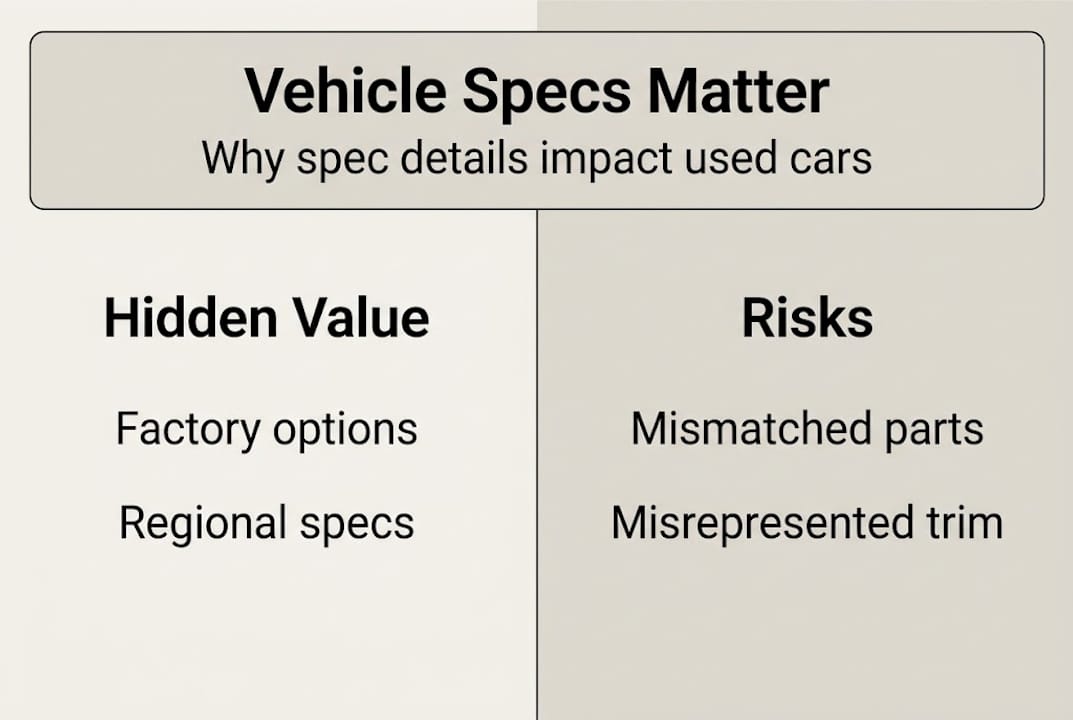
Here's a side-by-side comparison to make this concrete:
| Factor | GCC-spec / Local spec | Grey import / Non-local spec |
|---|---|---|
| Climate suitability | Optimized | Often not adapted |
| Parts availability | High | Variable or limited |
| Resale value | Stable | Often lower |
| Service compatibility | Full dealer support | Possible gaps |
| Insurance ease | Standard | May face complications |
The risk side of specs is equally important. Buyers who skip spec verification are exposed to:
- Paying for features that don't exist on the actual car
- Buying a car with safety ratings lower than advertised
- Discovering compliance issues at registration
- Facing warranty gaps if service history was built around wrong spec data
When comparing car models, it's not just about which car looks better on paper. It's about which car's specs hold up under scrutiny and serve your actual driving needs.
Key stat: Regional spec mismatches are a leading cause of post-purchase dissatisfaction in used car markets where imports are common. Treating spec confirmation as a purchase requirement, not an optional step, is one of the highest-leverage things you can do before signing anything.
Common pitfalls and red flags in vehicle specs
Even experienced buyers get caught. Spec fraud is sophisticated enough that a car can look entirely legitimate until you cross-reference the right documents. Knowing the top red flags puts you ahead of most buyers.
Top 5 spec inconsistencies to watch for:
- Trim mismatch: The listed trim doesn't match the features present, or VIN decoding reveals a lower trim than advertised.
- Engine type discrepancy: Advertised as a V6 but the VIN engine code confirms a four-cylinder. This affects insurance, performance, and value.
- Feature claims without documentation: Seller claims leather seats or a sunroof came from the factory, but the build sheet or VIN data shows otherwise.
- Build year confusion: The model year on the title doesn't align with the VIN's production year, a common sign of title washing.
- Import status misrepresentation: Sold as a local-market vehicle but VIN origin and spec data point to a grey market import.
Service records are another critical verification layer. If the records reference parts or service intervals that don't match the car's actual specs, that's a signal worth investigating. An oil filter listed in a service record that doesn't correspond to the engine in the VIN is a small but telling detail.
"Verifying specs via VIN and service records can reveal misrepresentation and is a critical due diligence step for any used car purchase."
Pro Tip: Ask the seller for the original window sticker or Monroney label if it's available. This document lists every factory option and the original MSRP, and it's almost impossible to fake. Combine it with a verification guide and you have a bulletproof cross-check.
For a full pre-purchase process, work through an essential vehicle history checklist alongside your spec review. The two together cover both the car's past and its present configuration.
How to verify and use vehicle specs when buying or maintaining a car
Verification sounds complicated, but the process is straightforward once you know what to look for and where to look. Here's the practical step-by-step approach.
Step-by-step spec verification:
- Get the VIN before anything else. Every legitimate seller will provide it. If they won't, walk away.
- Decode the VIN. Use a free tool to pull the original trim, engine, options, and build data. This is your baseline.
- Compare against the listing. Every claim in the ad should match the decoded spec data. Flag any discrepancy.
- Cross-check service records. Confirm that maintenance items in the records match the engine, transmission, and options the VIN confirms.
- Request original documentation. Window sticker, title, and any dealer inspection reports should all align with spec data.
- Check regional compliance. Confirm the car meets local emissions, safety, and registration standards for your area.
Here's a quick reference for what each document tells you:
| Document | What it confirms |
|---|---|
| VIN decode | Original trim, engine, options, production year |
| Service records | Mileage accuracy, maintenance alignment with specs |
| Title | Ownership history, any salvage or rebuilt flags |
| Window sticker | Factory options and original pricing |
| Inspection report | Current condition versus spec expectations |
Verifying with a VIN uncovers the original trim and options, and is the most reliable way to check mileage and history for discrepancies. If you want the full walkthrough, the step-by-step specs lookup guide covers every tool and document in detail.
After purchase, keeping accurate spec records pays off at resale. Buyers who can show clean, matching documentation get better offers and sell faster. Service history and value are directly connected, and digital car recordkeeping makes it easy to keep everything organized and ready to present.
A hard truth about vehicle specs most buyers miss
Here's what years of watching used car purchases go wrong has made clear: the problems that cost buyers the most money almost never come from visible flaws. Nobody buys a car with a dent and feels surprised by it. The real regrets come from what wasn't checked. Wrong trim, wrong engine spec, wrong import status. These are invisible at a glance and extremely expensive to discover after the paperwork is signed.
Conventional wisdom in used car buying is focused on price and appearance. Negotiate hard, look for clean paint, avoid high mileage. That advice isn't wrong, it's just incomplete. A car with 60,000 miles and a misrepresented spec is a worse deal than a car with 90,000 miles and a clean, verified history.
Shifting from deal-hunting mode to spec-verification mode is the mindset change that separates buyers who rarely have post-purchase problems from those who frequently do. Maintenance history matters, but only in context of a car that is what it claims to be. Start there.
Take the guesswork out: streamline your vehicle specs verification
Manually cross-referencing VINs, service records, and manufacturer data across multiple sources takes time and leaves room for error. AutoManual simplifies the entire process.
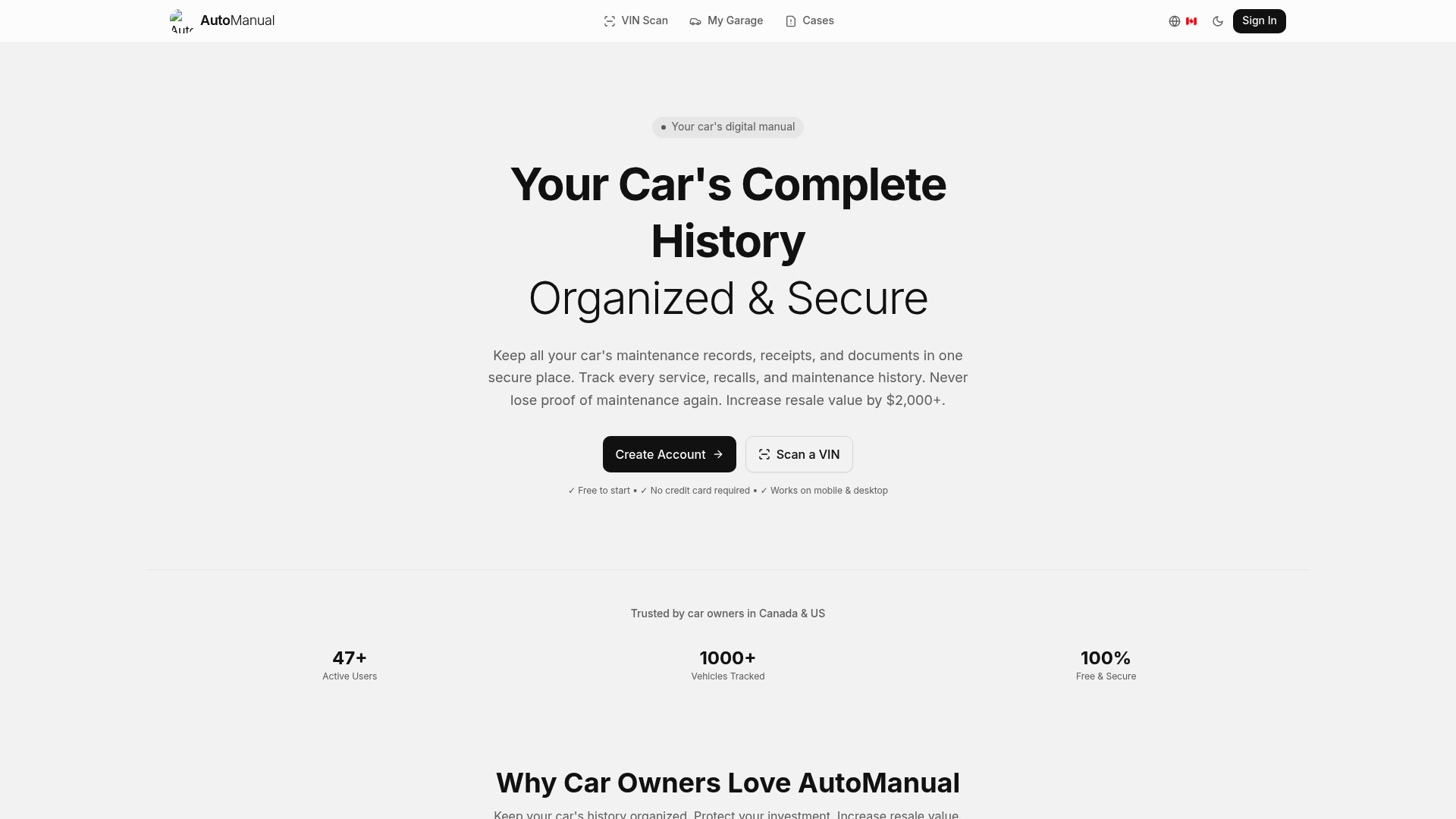
With AutoManual, you enter any VIN and instantly pull complete technical specs with no account needed. You get the trim, engine code, factory options, and build data in one clean view. Beyond the lookup, AutoManual works as a digital garage where you can track every vehicle you own or manage, storing specs, maintenance records, and documents all in one place. When you're ready to verify your next purchase or organize a car you already own, scan any vehicle and get the full picture in seconds.
Frequently asked questions
How can I verify a used car's specs match its advertised features?
Decode the VIN to get the original trim and factory options, then compare that data against the listing claims and service records. Any mismatch is a reason to ask hard questions before buying.
Why does import status or region-specific spec matter?
GCC-spec vehicles are built for specific climates and supported by local parts networks, which directly affects reliability and resale value. A grey import may look identical but cost significantly more to maintain.
What are the top red flags when reviewing vehicle specs?
Watch for VIN data that contradicts the advertised trim, engine codes that don't match, and service records that reference parts incompatible with the confirmed specs. These patterns often point to misrepresentation or prior accident damage.
How do accurate vehicle specs help with car maintenance?
Knowing the exact spec ensures you order the right parts, follow the correct service intervals, and avoid mistakes that come from servicing a car based on incorrect assumptions about its configuration.