

You found a used car that looks perfect online. The price is right, the photos are clean, and the seller sounds confident. Then you ask for the full specs and get a vague answer, a mismatched trim level, or worse, silence. Incomplete or inaccurate vehicle specs cost buyers real money every year, whether through overpaying for a stripped-down model or missing a safety recall. This guide walks you through every reliable method to find, verify, and save your car's exact specifications, so you never have to guess when making one of the biggest purchases of your life.
Table of Contents
- Essential information and tools you need before you start
- Step-by-step: How to decode your car's specs using the VIN
- Where to find official performance, efficiency, and safety data
- Troubleshooting and what to do if you hit a dead end
- Our expert perspective: What most guides miss about finding car specs
- Simplify your car spec search with AutoManual
- Frequently asked questions
Key Takeaways
| Point | Details |
|---|---|
| VIN is key | Your car’s complete 17-digit VIN unlocks its official specifications using reliable government tools. |
| Use multiple sources | Combine VIN decoding, performance data, and manuals to get the most accurate understanding of any vehicle. |
| Troubleshoot gaps | If standard tools fail, try manufacturer records, owner forums, or enthusiast groups for older or rare cars. |
| Document findings | Save all discovered specs and research in a single place to ensure informed decisions and easier maintenance. |
Essential information and tools you need before you start
Before you search for any spec, you need one thing above everything else: the Vehicle Identification Number, or VIN. Think of the VIN as a car's fingerprint. No two vehicles share the same one, and it encodes the factory details that define your specific car from the day it was built. Understanding your VIN is the single most important skill for any serious buyer or enthusiast.
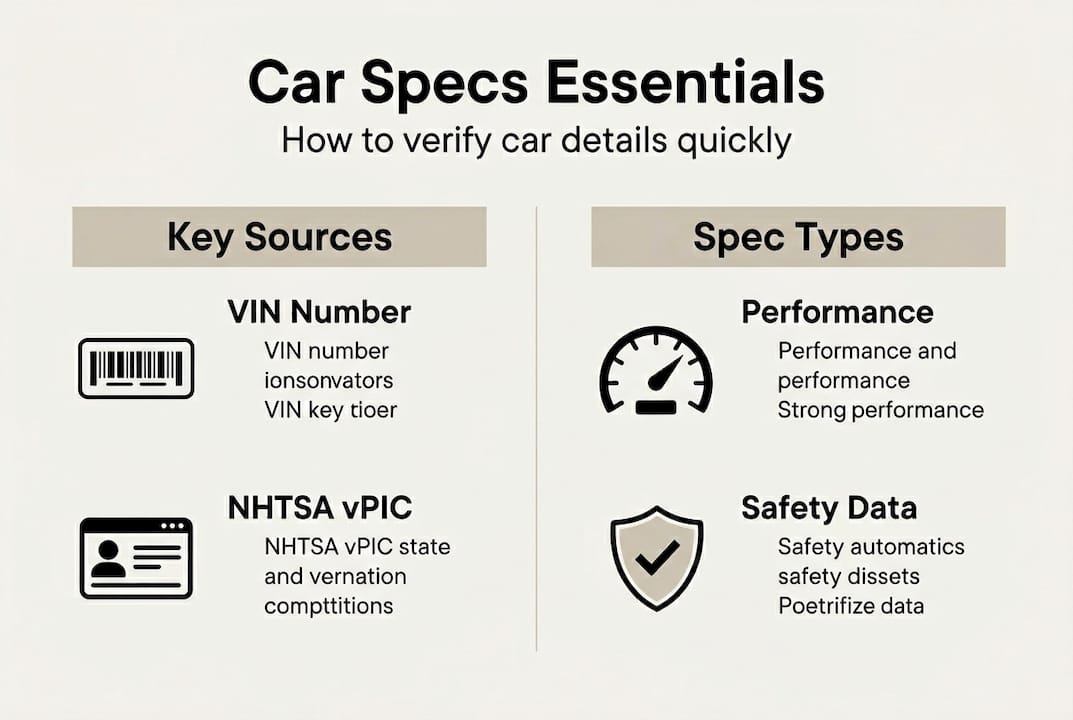
The official NHTSA VIN decoder is the gold standard for US vehicles. The NHTSA vPIC tool provides make, model, year, engine, body style, and drivetrain directly from manufacturer data, free of charge and with no account required. For most buyers shopping post-1981 vehicles, this is your first stop.
For older or imported cars, you may need to go beyond the VIN decoder. Manufacturer-specific documents, dealer records, and car owner's manual tips can fill in gaps that no online tool will cover. Having the registration, title, and physical manual on hand before you start saves significant time.
Here is a quick overview of what you need and where to find it:
| Resource | Best for | Cost |
|---|---|---|
| NHTSA vPIC decoder | Factory specs, post-1981 US vehicles | Free |
| Owner's manual | Trim-specific options, fluids, torque specs | Free (if available) |
| State DMV records | Title history, registration details | Varies by state |
| Manufacturer website | Current model specs, option codes | Free |
| Enthusiast forums | Rare models, pre-1981 vehicles | Free |
Key items to gather before you start:
- Full 17-digit VIN (found on the dashboard, door jamb, or title)
- Vehicle registration and title documents
- Owner's manual or service records
- Model year and trim level if known
- Any prior inspection or dealer reports
Having these ready means your search moves fast and your results are accurate from the start.
Step-by-step: How to decode your car's specs using the VIN
Now that you have the essential tools and understanding, let's move step-by-step through decoding any car's specs using your VIN.
- Locate the full 17-digit VIN. Check the lower left corner of the windshield from outside, the driver's side door jamb sticker, or your title and registration documents. All three should match.
- Go to the NHTSA vPIC decoder. The NHTSA's free VIN decoder is the most reliable source for factory data without cost for post-1981 vehicles. Enter the full VIN in the search field.
- Review the returned fields. You will see make, model, model year, engine displacement, fuel type, body class, drive type, number of doors, and more. Some fields may show as "Not Applicable" depending on the manufacturer's data submission.
- Cross-reference field definitions. Certain codes vary by manufacturer. For example, "AWD" may be listed differently across brands. Note any fields that seem unclear and verify them against the owner's manual.
- Check for edge cases. Pre-1981 vehicles lack the standardized 17-digit VIN format, so results will be limited or unavailable. For these cars, manufacturer-specific tools, collector forums, or vehicle history for older cars are your best alternatives.
- Save your results. Screenshot the full output or copy the data into a document. You will want this for comparison, insurance quotes, and future maintenance.
You can also run the same VIN through decoding with AutoManual to get a clean, organized view of the specs alongside any available history data.

| Method | Accuracy | Speed | Works pre-1981? |
|---|---|---|---|
| NHTSA vPIC | Very high | Instant | No |
| AutoManual decoder | High | Instant | Limited |
| Manufacturer lookup | High | Moderate | Sometimes |
| Collector forums | Variable | Slow | Yes |
Pro Tip: Always run the VIN on at least two sources. If the engine type or drivetrain listed on the seller's ad does not match what the NHTSA decoder returns, that is a red flag worth investigating before you sign anything.
Where to find official performance, efficiency, and safety data
Once you know your exact specs, go deeper by verifying how your car performs and how safe it is compared to others.
Factory specs tell you what a car was built with. They do not tell you how it actually performs in the real world. That is where official test data and expert benchmarks become essential for buyers who want the full picture.
Here is where to look for each category:
- Fuel economy: The EPA efficiency data portal gives official city, highway, and combined MPG figures for every model year. These numbers are tested under controlled conditions and are the most consistent benchmark for comparison shopping.
- Safety ratings: NHTSA and IIHS both publish crash test results. NHTSA rates vehicles on a five-star scale across multiple impact categories. IIHS uses a separate rating system with "Top Safety Pick" designations.
- Performance benchmarks: Car and Driver benchmarks include real-world 0-60 times, braking distances, and handling scores from instrumented tests. These numbers often differ from manufacturer claims, which is exactly why they matter.
- Towing and payload: Manufacturer towing guides and owner's manuals are the authoritative source here. Never rely on a seller's verbal estimate for towing capacity.
Pro Tip: When comparing car model benchmarks, always compare the same model year and trim. A base trim and a sport trim of the same car can have dramatically different braking and handling numbers.
One statistic worth knowing: according to Car and Driver, real-world 0-60 times from instrumented tests often run 0.3 to 0.5 seconds faster than manufacturer-published figures due to testing methodology differences. That gap matters if you are cross-shopping performance vehicles.
Combining EPA data, NHTSA safety scores, and enthusiast benchmark results gives you a three-dimensional view of any car that no single source can match. You can also track all of this alongside your VIN data using digital maintenance tracking tools that keep everything in one place.
Troubleshooting and what to do if you hit a dead end
Sometimes even with the right tools, you may run into challenges. Here's how to keep moving forward if things don't go as planned.
Not every VIN search ends with a clean result. Older vehicles, gray-market imports, and cars with incomplete records all present real obstacles. Here is how to handle the most common roadblocks:
- Missing or non-standard VIN: Cars built before 1981 used manufacturer-specific formats. Partial VIN decoding is possible but results are limited and less detailed. Contact marque-specific clubs or national registries for these vehicles.
- Data discrepancies between sources: If two official sources return different specs, do not guess. Pull the original window sticker if available, or contact the manufacturer's customer service line with the full VIN.
- Lost paperwork: Your state DMV can often provide title history and registration records. Dealer networks may also have service records tied to the VIN if the car was serviced at a franchise location.
- Rare or collector models: Enthusiast forums and model-specific registries are invaluable here. Owners who have lived with these cars for decades often know details that never made it into any database.
- Suspected fraud or tampering: Always find specs with AutoManual and cross-reference with vehicle history docs before any financial transaction. VIN plate tampering is a real risk in the used car market.
Pro Tip: If a seller pressures you to skip the VIN check or claims the decoder results are wrong, walk away. Legitimate sellers welcome verification.
"A car's spec sheet is only as trustworthy as the sources behind it. One database is a starting point. Two matching databases is confidence. Three is certainty."
The goal is not to become paranoid but to be systematic. Most cars check out fine. The ones that don't are exactly why this process exists.
Our expert perspective: What most guides miss about finding car specs
As you piece together your car's full history, here is a key insight most guides overlook.
VIN decoders are powerful, but they only capture what the manufacturer reported at the time of production. They cannot tell you whether the original engine was swapped, whether the car was modified for a specific market, or whether a previous owner installed non-factory components that changed how the vehicle actually drives.
The buyers and enthusiasts who get the most accurate picture are the ones who treat spec research as a layered process, not a single lookup. They run the VIN, then check the manual, then verify performance data from independent tests, then scan owner forums for model-specific quirks. Each layer catches something the previous one missed.
There is also a long-term value argument here. Keeping a systematic record of your car's specs, modifications, and service history in full digital car profiles does not just protect you today. It makes your car easier to sell, easier to insure accurately, and easier to maintain correctly over time. Most people skip this step and pay for it later in diagnostic confusion or resale disputes.
The uncomfortable truth is that a 10-minute VIN lookup feels complete but rarely is. The extra 30 minutes you spend cross-referencing sources is the difference between buying with confidence and buying with hope.
Simplify your car spec search with AutoManual
If you want a seamless, all-in-one approach to finding and managing car specs, here's your next step.
AutoManual makes the entire process faster and more organized. Enter any VIN into the AutoManual Scan tool and get instant access to full factory specs with no account or signup required. The platform pulls manufacturer data and presents it in a clean, readable format that is easy to save and share.
Beyond the initial lookup, AutoManual works as a car spec digital vault where you can store specs, maintenance records, documents, and ownership details for every vehicle you own or are considering. It is the kind of organized, accessible record that protects your investment from day one. Start your free VIN scan today and know exactly what you are buying or maintaining.
Frequently asked questions
What are the most trusted sites for decoding a car VIN?
The NHTSA vPIC website is the most reliable free resource for factory VIN specs on US vehicles manufactured after 1981. AutoManual also provides a fast, user-friendly decoder built on verified manufacturer data.
Can I find full specs with only part of my car's VIN?
Partial VINs can return some manufacturer information, but full specs require the complete 17-digit VIN. Pre-1981 vehicles used non-standard formats, so manufacturer-specific tools or documentation are needed for those models.
Where do I find horsepower and acceleration data for my car?
Performance specs like horsepower and 0-60 benchmarks are available from instrumented-test sources such as Car and Driver, and from manufacturer brochures or window stickers for the original model year.
How do I check if my car has been modified from factory specs?
Run the VIN through an official decoder to get the original factory configuration, then compare those results against the car's current state and any available service records. Discrepancies in engine type, drivetrain, or trim details are strong indicators of modifications.