

Most car owners glance at their manual once, toss it in the glove box, and never open it again. That's a costly habit. Your owner's manual is packed with model-specific guidance on maintenance schedules, warning lights, safety systems, and features you're probably not using. Skipping it means paying for services you don't need, missing warranty protections, and fumbling with tech that's already explained in plain language. This guide breaks down exactly what's inside your manual, how to use it for maintenance and safety, and why it matters whether you're a current owner or shopping for a used car.
Table of Contents
- What is a car manual and why does it matter?
- Inside the manual: What's included and why it matters
- Manual-recommended maintenance: Schedules, costs, and real-world nuances
- Troubleshooting and safety: Using the manual to decode warning lights and tech
- Manuals for car buyers: Assessing used vehicles and records
- Digitize and organize your car manual and records
- Frequently asked questions
Key Takeaways
| Point | Details |
|---|---|
| Manuals guide safe operation | Owner's manuals provide crucial instructions, specs, and warnings to keep you safe and avoid common mistakes. |
| Maintenance schedules cut costs | Following manual recommendations helps prevent expensive repairs and keeps annual maintenance spending lower. |
| Troubleshooting with manuals | Car manuals offer clear guidance for decoding warning lights and handling technology, reducing panic and mistakes. |
| Manuals boost buyer confidence | A complete manual enables buyers to verify records, spot issues, and make smarter purchase decisions. |
What is a car manual and why does it matter?
A car manual is your vehicle's official instruction guide, written by the manufacturer specifically for your make, model, and trim level. But not all manuals are the same. There are two main types every owner and buyer should know.
| Manual type | Who it's for | What it covers |
|---|---|---|
| Owner's manual | Everyday drivers | Operation, basic maintenance, specs, warranty |
| Service manual | Mechanics, advanced DIYers | Detailed repair procedures, wiring diagrams, torque specs |
Owner's and service manuals serve completely different purposes. The owner's manual tells you how to operate your car safely and keep it running. The service manual tells a technician how to fix it when something breaks. Confusing the two leads to frustration fast.
Here's what a typical owner's manual covers:
- Engine specs and fluid types (the exact oil grade your engine needs)
- Tire pressure and load ratings (not the number on the tire sidewall)
- Scheduled maintenance intervals (oil, filters, brakes, belts)
- Warranty terms and conditions
- Dashboard warning light definitions
- Safety system operation (airbags, ABS, traction control)
Why does this matter for ownership? Because dealers and quick-lube shops sometimes recommend services earlier than your manufacturer requires. Knowing your manual's actual intervals puts you in control. It also matters when you're researching a vehicle's history, which connects directly to understanding car titles and ownership records.
"The owner's manual is the single most underused resource available to car owners. It's written specifically for your vehicle, not a generic model." — Consumer Reports
Inside the manual: What's included and why it matters
Open any owner's manual and you'll find far more than basic instructions. Manufacturers pack these documents with information that can save you real money and prevent real headaches.
Manuals detail oil checks, filter changes, dashboard lights, infotainment systems, driving tips, and warranty information. That's a lot of ground covered in one document. Here's what owners most commonly overlook:
- Infotainment and connectivity setup: Pairing Bluetooth, using Apple CarPlay or Android Auto, and adjusting driver assist settings are all explained step by step.
- Driving mode differences: Many modern vehicles have eco, sport, or comfort modes that change throttle response and fuel consumption. The manual explains what each actually does.
- Fluid check procedures: Not just oil. Coolant, brake fluid, power steering fluid, and transmission fluid all have specific check and fill procedures.
- Tire rotation patterns: Front-wheel drive, rear-wheel drive, and all-wheel drive vehicles rotate tires differently. Getting this wrong accelerates wear.
- Warranty exclusions: Certain modifications or missed services can void coverage. The manual spells this out clearly.
Pro Tip: Bookmark the dashboard warning lights section on your phone's PDF reader. When a light appears, you'll have the answer in seconds instead of guessing or paying for a diagnostic scan.
Modern vehicles are loaded with safety technology that most drivers never fully understand. Lane keep assist, automatic emergency braking, and blind spot monitoring all have sensitivity settings and operational limits explained in the manual. Ignoring these sections means you're driving with tools you don't fully control. You can also use your manual to track car maintenance more accurately by cross-referencing what was done against what was scheduled.

Manual-recommended maintenance: Schedules, costs, and real-world nuances
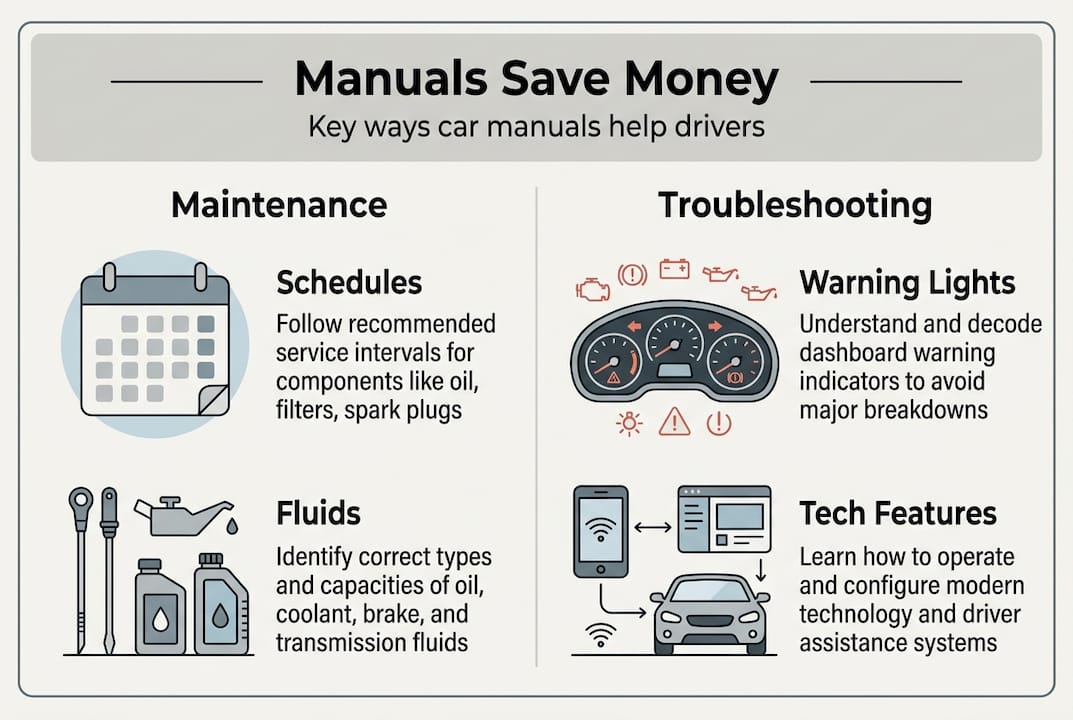
Following your manual's maintenance schedule is one of the highest-return habits you can build as a car owner. The numbers back this up clearly.
| Vehicle | Avg. annual maintenance cost (schedule followed) | Common neglect result |
|---|---|---|
| Toyota Corolla | $362/year | Transmission wear, oil sludge |
| Mazda 3 | $471/year | Oil consumption issues |
| Ford F-150 | $788/year | Spark plug failure, coolant leaks |
Vehicles following schedules show measurably lower repair frequency and costs. Neglect, on the other hand, compounds quickly. A missed timing belt service can turn a $400 job into a $4,000 engine repair.
Here's how to apply your manual's schedule in the real world:
- Identify your driving condition: Manuals list "normal" and "severe" service schedules. Severe includes frequent short trips, towing, dusty environments, or extreme temperatures.
- Set calendar reminders: Don't rely on mileage alone. Time-based intervals matter for fluids that degrade even when the car sits.
- Cross-check with your actual records: Compare what's been done to what was due. Gaps reveal deferred maintenance.
- Adjust for synthetic oil: Modern synthetics allow 7,500 to 10,000 miles between changes, not the outdated 3,000-mile rule. But severe service conditions shorten that interval regardless of oil type.
- Document everything: Keep receipts and service records organized by date and mileage.
Pro Tip: If you bought a used car without full service records, use the manual's maintenance schedule as a baseline. Assume any service without documentation was never done, and start fresh from your current mileage.
Manufacturer maintenance intervals are often set conservatively to protect warranty coverage, not necessarily to maximize engine longevity. In harsh conditions, going slightly shorter than the manual recommends is rarely a bad idea.
Using your manual alongside a solid car history checklist gives you a complete picture of where a vehicle stands mechanically.
Troubleshooting and safety: Using the manual to decode warning lights and tech
A warning light appears on your dashboard. Your first instinct might be panic or a quick internet search. Your best move is actually opening your manual.
Owner's manuals provide guidance on warning lights, safety systems, troubleshooting, and understanding features. Every symbol in your instrument cluster is defined, color-coded by urgency, and paired with a recommended action. Red means stop soon. Yellow means monitor and schedule service. That distinction alone can prevent unnecessary panic or, more importantly, prevent you from ignoring something serious.
Here's what the troubleshooting sections typically help you handle:
- Check engine light: The manual explains common triggers and whether it's safe to continue driving.
- Tire pressure monitoring system (TPMS): How to reset it after inflation and what the flashing warning means.
- Battery and charging warnings: When to pull over immediately versus when to drive to a shop.
- Infotainment resets: Most systems have a soft reset procedure that fixes freezes without a dealer visit.
- Brake system warnings: The difference between a parking brake reminder and an actual brake failure alert.
Pro Tip: Many manufacturers now offer digital versions of their manuals through official apps or websites. Search your brand name plus "digital owner's manual" to find yours. It's searchable, which makes finding specific warning lights or procedures much faster than flipping through pages.
For safety systems like airbags, ABS, and electronic stability control, the manual explains operational limits. Airbags, for example, have weight thresholds for front passenger deployment. ABS doesn't stop you faster on gravel. Knowing these limits makes you a safer, more informed driver. Pairing this knowledge with quality car safety accessories adds another layer of protection on the road. You can store your digital manual and related documents in your digital car vault for instant access anytime.
Manuals for car buyers: Assessing used vehicles and records
If you're shopping for a used car, the presence of an owner's manual is a small but meaningful signal. It suggests the previous owner cared enough to keep the vehicle's documentation intact.
Owner's manuals help avoid dealer dependency and save costs by giving buyers direct access to specs and maintenance requirements. Here's how to use a manual during a used car evaluation:
- Verify the maintenance schedule: Compare what the manual requires against the service records provided. Missing entries are red flags.
- Check fluid specs: Confirm the seller used the correct oil grade and transmission fluid type. Wrong fluids cause long-term damage that doesn't show up immediately.
- Confirm tire specs: The manual lists the correct tire size and load rating. Mismatched tires affect handling and safety.
- Review warranty transfer terms: Some manufacturer warranties are transferable. The manual outlines the conditions.
- Assess feature completeness: Confirm all listed features are present and functional before purchase.
Pro Tip: If the manual is missing, you can often download a PDF version from the manufacturer's website for free. Use it to build your own evaluation checklist before the test drive.
Combining manual review with a thorough vehicle history checklist gives you the most complete picture of any used car's condition and ownership history. Don't skip either step.
Digitize and organize your car manual and records
You now know your manual is one of the most valuable tools you own as a driver or buyer. The next challenge is keeping it accessible. Paper manuals get lost, damaged, or left behind during a sale.
AutoManual makes it easy to store, access, and manage everything in one place. You can scan your car manual and upload it directly to your vehicle's digital profile, where it lives alongside your maintenance history, specs, and ownership documents. No signup required to get started. Your digital car profile becomes a complete record of your vehicle that you can access from any device, share with a mechanic, or hand off to a buyer with full confidence. It's the practical next step after everything you've learned here.
Frequently asked questions
What is the difference between an owner's manual and a service manual?
Owner's and service manuals serve different audiences. Owner's manuals focus on operation and basic maintenance for everyday drivers, while service manuals provide detailed repair instructions for mechanics and advanced DIYers.
How often should I follow the maintenance schedule in my owner's manual?
Follow the manual schedule for normal driving conditions, but shorten intervals if you drive in harsh environments. Modern synthetics allow 7,500 to 10,000 miles between oil changes, but severe service conditions override that guideline.
Can I use manuals to troubleshoot dashboard warning lights?
Yes. Owner's manuals provide guidance on every dashboard symbol, including color-coded urgency levels and recommended actions for each warning.
Why is the presence of a manual important when buying a used car?
A manual lets you verify that maintenance records match what the manufacturer actually required. It also signals that the previous owner maintained proper documentation, which increases buyer confidence and resale value.