

Buying a used car without comparing models is like picking a restaurant without reading the menu. You might get lucky, but the odds aren't in your favor. Used cars save on depreciation, but they also carry hidden reliability risks that only surface when you dig into the specs and ownership history. A structured model comparison isn't just for car enthusiasts obsessing over horsepower figures. It's the single most effective way for any buyer to avoid overpaying, sidestep chronic repair costs, and walk away with a vehicle that actually fits their life.
Table of Contents
- Why comparing car models matters
- Performance metrics versus real-world value
- Methodologies and comparison tools for buyers
- Nuances: What most people miss when comparing models
- Applying model comparisons to your buying decision
- The easiest way to track and compare your car models
- Frequently asked questions
Key Takeaways
| Point | Details |
|---|---|
| Model comparison avoids costly mistakes | Comparing car models helps buyers steer clear of depreciation risks and hidden maintenance costs. |
| Performance metrics demand context | Numbers like horsepower are less meaningful than ratios and test results, especially for enthusiasts. |
| Reliable sources matter most | Tools, test scores, and expert data provide a trustworthy foundation for comparing and choosing cars. |
| Edge cases must be checked | Specs can mislead; real-world testing and vehicle history ensure you don’t miss crucial details. |
| Digital tracking simplifies decisions | Maintaining digital car records saves time and enhances comparison accuracy for buyers and enthusiasts. |
Why comparing car models matters
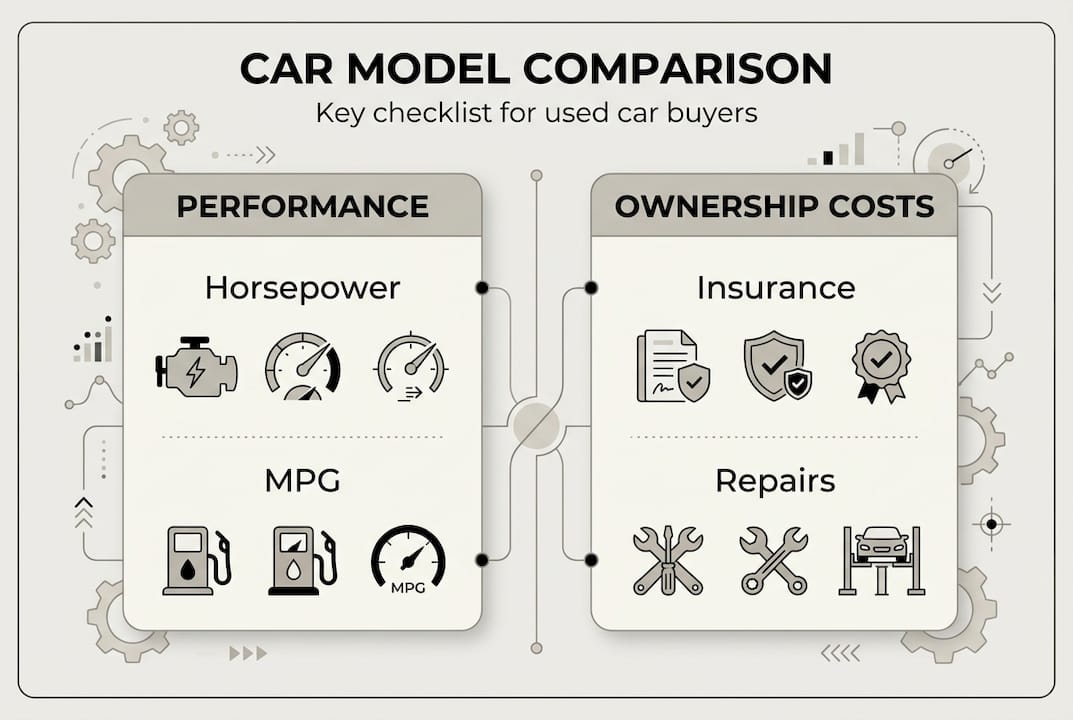
Every used car purchase is a financial decision first. The sticker price is just the beginning. Depreciation, insurance rates, fuel economy, and repair frequency all stack up over time, and the model you choose determines most of those costs before you even sign anything.
Used car buyers compare models to assess value, reliability, safety, features, and total ownership costs, avoiding high depreciation and ensuring informed decisions on maintenance risks. That's not a minor checklist item. That's the entire framework for making a purchase you won't regret two years later.
Here's what smart comparison actually covers:
- Depreciation curve: Some models lose 40% of their value in the first three years. Others hold value far better, which matters when you eventually resell.
- Reliability track record: A model with a history of transmission problems will cost you, regardless of how good the deal looks upfront.
- Safety ratings: NHTSA and IIHS scores vary significantly between model years, not just between brands.
- Feature fit: A loaded trim on a budget model may still lack features a base trim on a better model includes standard.
- Total cost of ownership: Insurance, fuel, tires, and scheduled maintenance all differ by model.
"The cheapest car to buy is rarely the cheapest car to own." That gap between purchase price and ownership cost is exactly where model comparison earns its value.
Enthusiasts and buyers approach this differently. Enthusiasts often prioritize driving dynamics and powertrain options. Buyers typically focus on reliability and cost. But both groups benefit from using a solid vehicle history checklist before committing. A used car guide can also help frame the broader new-versus-used decision before you narrow down specific models.
Performance metrics versus real-world value
Horsepower is the number everyone quotes. It's also one of the least useful specs in isolation. A 300-horsepower sedan that weighs 4,200 pounds will feel slower than a 220-horsepower coupe that weighs 2,900 pounds. The power-to-weight ratio tells you far more about how a car actually moves.
Car enthusiasts compare specs like power-to-weight ratio, acceleration, handling, and braking to evaluate real-world performance beyond raw numbers, prioritizing driving dynamics over headline figures. That's the right instinct, and it applies to everyday buyers too, not just track-day regulars.

Here's a quick comparison of how two popular used sedans stack up on key performance metrics:
| Metric | Honda Accord (2022) | Toyota Camry (2022) |
|---|---|---|
| Horsepower | 192 hp | 203 hp |
| Curb weight | 3,131 lbs | 3,310 lbs |
| Power-to-weight | 61.4 hp/1000 lbs | 61.3 hp/1000 lbs |
| 0-60 mph | 7.1 sec | 7.4 sec |
| EPA combined MPG | 33 mpg | 32 mpg |
On paper, the Camry has more horsepower. In practice, the Accord accelerates faster because it's lighter. That's the kind of insight raw spec sheets miss.
Pro Tip: Always cross-reference manufacturer claims with independent track tests. Automakers measure performance under ideal conditions. Real-world results from sources like Consumer Reports or Car and Driver often tell a different story. A good car manuals guide can also help you decode what factory specs actually mean for day-to-day driving.
For used car buyers, the safe used car guide from Consumer Reports is one of the best resources for understanding how performance and safety intersect across model years.
Methodologies and comparison tools for buyers
Knowing what to compare is only half the job. You also need reliable tools and methods to do the comparing accurately.
Side-by-side comparison tools compare specs including price, MPG, horsepower, and safety ratings, while benchmarks from Consumer Reports and Car and Driver use controlled track tests to validate real-world performance. These aren't just convenient shortcuts. They're the closest thing to objective data in a market full of seller spin.
Here's a structured approach to model comparison:
- Start with your budget and needs: Define your non-negotiables first. Cargo space, fuel economy, towing capacity, or safety ratings. This filters out irrelevant models fast.
- Use side-by-side tools: Edmunds, KBB, and Car and Driver all offer direct spec comparisons. Run at least two models against each other before shortlisting.
- Check reliability scores: Consumer Reports publishes annual reliability data by model and year. Car brand test scores show which manufacturers consistently perform well across categories.
- Review safety ratings: Pull NHTSA and IIHS scores for the specific model year you're considering, not just the generation.
- Factor in ownership costs: Use Edmunds True Cost to Own for a five-year projection that includes depreciation, insurance, fuel, and maintenance.
| Comparison category | Best free tool | What it measures |
|---|---|---|
| Specs and price | Edmunds / KBB | MSRP, MPG, HP, dimensions |
| Reliability | Consumer Reports | Owner-reported repair frequency |
| Safety | NHTSA / IIHS | Crash test scores by year |
| Road performance | Car and Driver | Track-tested 0-60, braking |
Pro Tip: Don't compare just the base trim. A model that scores well in reviews is often tested in a mid or top trim. Make sure you're comparing the same trim level across models, or you'll be looking at apples and oranges.
Once you've selected a model, car ownership tracking and digital car recordkeeping become your next tools for staying on top of maintenance and resale value.
Nuances: What most people miss when comparing models
Even buyers who do their homework often fall into the same traps. The specs look right. The price is fair. But something gets missed, and it costs them later.
Specs can mislead: a lighter car can outperform a heavier one despite having less horsepower, and claimed performance figures often don't match real-world results depending on tire type and conditions. First-year models carry extra risk because early production runs haven't had time to surface design flaws.
Here are the nuances that separate sharp buyers from average ones:
- Tire type changes everything: A performance-spec tire on one model versus an all-season on another will skew braking and handling comparisons significantly. Always check what tires were used in published tests.
- Model year matters more than generation: A 2019 and 2021 version of the same model can have completely different reliability profiles if a mid-cycle refresh introduced new components.
- Powertrain reliability is separate from overall reliability: A car can score well overall but have a known issue with a specific transmission or engine variant. Dig into powertrain-specific data.
- First-year models carry extra risk: When a manufacturer launches an entirely new model or redesign, the first production year often has higher defect rates. Waiting for the second or third year of a generation is a smart move.
"A car that looks great on a spec sheet but has a troubled first-year history is a liability, not a bargain."
Using a thorough used car checklist helps you catch these issues before they become your problem. The used car edge cases section of a good buying guide will also walk you through scenarios where standard advice breaks down.
Applying model comparisons to your buying decision
All the research in the world means nothing if you can't translate it into a confident purchase. Here's how to close the loop from comparison to decision.
Buyers compare to match needs and budget, using tools like KBB and Edmunds to review specs, while experts recommend certified pre-owned vehicles for used car reliability assurance. CPO programs add a layer of protection that private sales simply can't match.
Follow this process to move from research to purchase:
- Shortlist two or three models that meet your core requirements. More than three creates decision fatigue without adding clarity.
- Pull reliability data for the specific model year, not just the model. A 2018 version of a car can have a very different track record than a 2020.
- Request or run a vehicle history report for any specific car you're seriously considering. Accident history, title issues, and odometer discrepancies all show up here.
- Test drive each shortlisted model back to back if possible. Specs tell you what a car can do. A drive tells you how it feels to live with it.
- Calculate total ownership cost for your top two choices using a five-year projection. The cheaper car upfront is often the more expensive car over time.
Pro Tip: Use the history checklist as your final filter before making an offer. It catches the issues that comparison tools and spec sheets don't cover, like flood damage, salvage titles, or inconsistent service records. Consumer Reports also offers safe car buying tips that complement your comparison research perfectly.
The easiest way to track and compare your car models
You've done the research, narrowed your list, and you're ready to make a move. The last thing you want is to lose track of specs, service records, or comparison notes scattered across browser tabs and paper printouts.
AutoManual is a free VIN decoder and digital garage that pulls full technical specs for any vehicle instantly, no signup required. Enter a VIN and get the complete picture: engine specs, trim details, factory options, and more. Once you own a vehicle, the platform lets you store maintenance history, documents, and ownership details all in one place. You can build a digital car profile for every vehicle you're comparing or already own, making it easy to track what you have and evaluate what you're considering next. For buyers and enthusiasts who take comparison seriously, it's the organizational layer that ties everything together.
Frequently asked questions
What is the most important spec to compare between car models?
Power-to-weight ratio gives a more accurate sense of performance than horsepower alone, but for used car buyers, reliability and safety scores from Consumer Reports are the most critical factors in the decision.
How do I know if a used car's reliability data is trustworthy?
Look for models with strong Consumer Reports reliability scores and verify that the specific model year you're considering has a complete and consistent maintenance history.
When comparing two cars, which cost factors matter most?
Total ownership cost covers depreciation, insurance, fuel, and repair frequency. Used cars generally cost less upfront but require careful reliability checks to avoid higher long-term repair bills.
Is it safer to buy a used car from a later model year?
Yes. Newer used cars typically include improved safety technology, and avoiding first-year models reduces the risk of running into unresolved design or manufacturing issues from early production runs.