
Missing service records can quietly cost you thousands. A car with no documented history can lose up to 40% of its value compared to an identical vehicle with complete paperwork. Whether you're buying a used car or preparing to sell one, understanding how to check, read, and maintain service history is one of the highest-return skills you can develop. This guide walks you through everything: what service history actually is, how to verify it, what red flags to watch for, and how to use it to your advantage on both sides of a transaction.
Table of Contents
- What is vehicle service history and why does it matter?
- Essential tools and sources for checking service history
- Step-by-step guide: How to read and interpret service history
- Common mistakes and red flags in service history
- How mechanics and buyers use service history
- Why documentation matters more than most people realize
- Take control of your vehicle records with AutoManual
- Frequently asked questions
Key Takeaways
| Point | Details |
|---|---|
| Full history boosts value | Having every service documented can add thousands to your resale price. |
| Verify from multiple sources | Use VIN, reports, and manual intervals to check accuracy and completeness. |
| Watch for record gaps | Missing or unclear records may signal issues—and often mean lower value. |
| Go digital for easier tracking | Digital and photo records are simple to maintain and impress buyers. |
| Small details matter | Even minor maintenance entries build confidence and can tip a buyer’s decision. |
What is vehicle service history and why does it matter?
Vehicle service history is the complete record of every maintenance and repair event a car has gone through. Think of it as a medical chart for your vehicle. It includes oil changes, brake inspections, timing belt replacements, tire rotations, and any major repairs. These records come in three forms: full service history (FSH), partial history, and no history at all.
Full service history means every scheduled service has been completed on time and documented, usually with stamps in the owner's manual or digital entries in a dealer system. Partial history means some records exist but gaps are present. No history means the buyer is flying blind.
The financial impact is real. A complete service history can increase a used car's resale value by 15 to 25% compared to similar vehicles without documentation. And if you're selling through a dealership, main dealer FSH adds an extra 5 to 10% over independent service records.
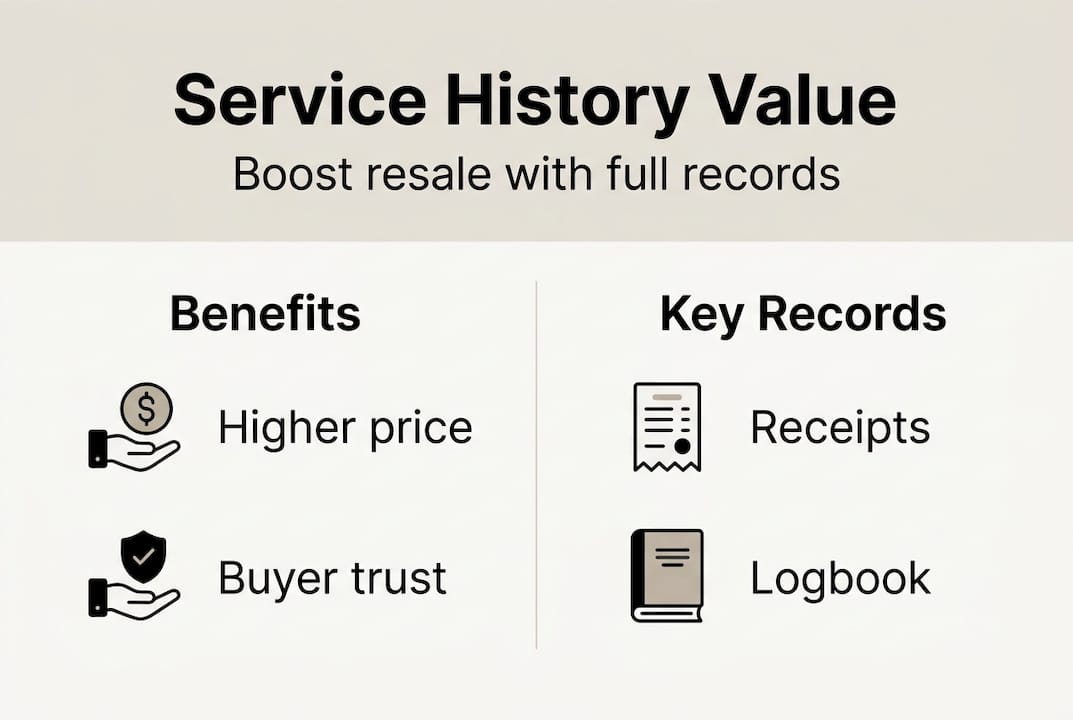
Here's a quick breakdown of how history type affects value:
| History type | Typical value impact |
|---|---|
| Full service history (dealer) | +15 to 25% |
| Full service history (independent) | +10 to 20% |
| Partial service history | Neutral to -15% |
| No service history | Up to -40% |
Beyond resale, service history helps you understand what the car has been through. It tells you whether the previous owner respected the manufacturer's maintenance schedule or skipped critical services. That context directly affects reliability and future repair costs.
"A well-documented car doesn't just sell faster — it sells for more, because buyers are paying for peace of mind, not just metal."
Digital records are becoming the norm for vehicles from 2012 onward, with many automakers storing service data in their own databases. But for older vehicles, paper stamps and receipts are still the gold standard. Either way, the resale price impact of solid documentation is hard to ignore.
Essential tools and sources for checking service history
Knowing the value of service history is one thing. Actually verifying it is another. Here's a quick-reference table of every tool you'll need:
| Tool | What it tells you | Where to get it |
|---|---|---|
| VIN (vehicle identification number) | Unique car identifier | Dashboard, door jamb, title |
| Carfax or AutoCheck report | Reported service events, accidents | Carfax.com, AutoCheck.com |
| Owner's manual | Manufacturer service intervals | Glove box or OEM website |
| Seller documents | Receipts, stamps, dealer printouts | Ask the seller directly |
| Digital OEM records | Dealer-logged services (2012+) | Dealership service department |
To check service history properly, follow these steps:
- Get the VIN. It's on the dashboard near the windshield, on the driver's door jamb, or on the vehicle title. This 17-character code unlocks everything.
- Run a Carfax or AutoCheck report. These pull from insurance claims, dealer records, and state DMV data to show reported service events.
- Request all seller documents. Ask for the physical service booklet, any dealer printouts, and receipts for independent work.
- Compare to the owner's manual. Check whether services were completed at the right mileage intervals.
- Verify mileage progression. Each service record should show increasing mileage. Jumps or inconsistencies are red flags.
Pro Tip: Carfax and AutoCheck miss DIY and independent work entirely. Always ask the seller for physical receipts or photos of any work done outside a dealership. A seller who can't produce a single receipt for five years of ownership is a warning sign.
Never rely on a single source. Cross-check the history report against the physical booklet and the owner's manual intervals. Use the history checklist to stay organized, and if you're unsure about the VIN itself, understanding VIN structure can help you decode what the number actually reveals about the car's origin and specs.
Step-by-step guide: How to read and interpret service history
Once you have the records in hand, reading them correctly takes a bit of practice. Here's how to work through them without missing anything important.
- Check every entry for date and mileage. Each service record should list when the work was done and how many miles were on the car. This lets you calculate whether intervals were respected.
- Match services to manufacturer benchmarks. Open the owner's manual and compare. Key maintenance benchmarks include oil changes every 5,000 to 10,000 miles, timing belt replacement at 60,000 to 100,000 miles, and brake inspections every 2 years.
- Look for high-cost items. Has the timing belt been replaced? What about the transmission fluid? These are expensive if skipped and critical for reliability.
- Identify who did the work. Dealer records carry more weight than unknown independent shops, but a reputable independent shop with consistent records is still valuable.
- Flag any gaps. If a car has 90,000 miles but only shows services at 15,000 and 80,000, something is missing. Either records were lost or maintenance was skipped.
Red flags to watch for:
- Mileage that doesn't increase logically between entries
- Missing timing belt record on a high-mileage vehicle
- Oil changes spaced more than 15,000 miles apart
- Brake service never recorded despite 60,000+ miles
Pro Tip: If the car was used for towing, rideshare, or frequent short trips, severe driving conditions cut recommended intervals roughly in half. A car used for Uber with oil changes every 10,000 miles is actually overdue. Ask the seller how the car was used. Cross-reference with the car manuals guide to understand what the manufacturer actually recommends for different driving conditions.
Common mistakes and red flags in service history
Even experienced buyers make avoidable mistakes when reviewing service records. Here's what to watch for on both sides of the transaction.
Top buyer mistakes:
- Accepting verbal claims without paper backup
- Trusting a Carfax report as the complete picture
- Ignoring minor service gaps because the price is good
- Not asking about DIY repairs or fluid top-offs
Red flags in the records themselves:
- Gaps of 20,000+ miles between any service entries
- Mileage that appears to go backward or stay flat
- Receipts from multiple states with no clear explanation
- Missing records for high-wear items like brakes, tires, or coolant
- Stamps that look altered or inconsistent in ink color
Even small details matter. A seller who kept records of every fluid change, even routine ones, signals a careful owner. That attention to detail builds buyer confidence and directly supports your asking price.
"Missing or partial service history reduces value by 10 to 35%, with no history at all causing up to a 40% drop — a gap that can represent thousands of dollars on a mid-range vehicle."
For owners preparing to sell, the lesson is clear: start ownership tracking now, even if your records aren't perfect. A partial history is always better than none. And going forward, digital recordkeeping makes it easy to capture every service without losing a single receipt.
How mechanics and buyers use service history
Service history isn't just a sales tool. Mechanics rely on it every time a car comes into the shop.
How mechanics use service records:
- Diagnosing recurring issues by spotting patterns across multiple visits
- Predicting what's due next based on mileage and last service date
- Verifying manufacturer compliance for warranty claims
- Avoiding repeat work by knowing what's already been replaced
According to repair professionals, service history helps mechanics diagnose recurring issues, predict upcoming needs, and confirm whether the car qualifies for warranty coverage. Without it, a mechanic is essentially starting from scratch every visit.

For buyers, the records serve a different but equally important purpose. Here's a sample of what a service history might reveal and what it means:
| Service entry | Mileage | Buyer takeaway |
|---|---|---|
| Oil change | 5,000 intervals | Owner followed schedule |
| Timing belt replaced | 95,000 | Major cost already covered |
| Brakes not recorded | 75,000+ miles | Potential near-term expense |
| Transmission fluid | 60,000 | Reduces long-term risk |
| No coolant flush | 80,000 | Watch for overheating issues |
For sellers and owners, consistent maintenance tracking does double duty: it keeps the car running well and builds the paper trail that justifies a higher asking price. A car with a clean, verifiable record is simply easier to sell and commands more money.
Why documentation matters more than most people realize
Here's something the typical advice misses: it's not just about having records. It's about having verifiable records that tell a coherent story.
A folder of random receipts with no clear mileage progression actually creates doubt, not confidence. What buyers and mechanics want is a timeline that makes sense. Every entry should connect logically to the next. That's what separates a trustworthy history from a pile of paper.
The shift toward digital records changes this dynamic entirely. Digital and photo records of all services and receipts maximize resale value because they're timestamped, searchable, and hard to fake. Even minor entries like a fluid top-off or a tire rotation add layers of trust when they're part of a consistent digital log.
Buyers in 2026 increasingly expect this level of transparency. A seller who can pull up a complete digital history on their phone during a test drive has a serious advantage. The digital tracking approach isn't just convenient — it's becoming the baseline expectation in the used car market.
Start building that record now, even if you're not planning to sell. Future you will be grateful.
Take control of your vehicle records with AutoManual
Your service history is only as useful as your ability to access and present it. AutoManual makes that effortless.

With AutoManual's free digital garage, you can store every service record, receipt, and maintenance note in one place — organized by vehicle and accessible anytime. Enter any VIN at AutoManual to instantly pull full technical specs and start building your vehicle's digital profile. When it's time to sell, you'll have a complete, verifiable history ready to share. Ready to get started? Scan your service history today and turn your records into real resale value.
Frequently asked questions
How much does a complete service history increase resale value?
A fully documented service history can raise your resale value by 15 to 25%. On a $20,000 car, that's an extra $3,000 to $5,000 in your pocket.
What are the fastest ways to check a used car's service history?
Use the VIN to request Carfax or AutoCheck reports, examine all seller documents, and compare recorded services to your owner's manual maintenance intervals.
What red flags should I look for when reviewing service records?
Watch for large mileage gaps, missing or partial records, mismatched mileage between entries, and no documentation for high-wear items like timing belts or brakes.
Do digital records count as valid service history?
Yes. Digital records are increasingly verifiable through OEM databases, especially for vehicles from 2012 onward, and they can significantly boost buyer confidence during a sale.