

TL;DR:
- Production year, engine size, and mileage explain more price variation than other factors.
- Comparing key specs helps identify true value over superficial features like color or trim.
- Combining specs with condition history and records ensures smarter, more confident used car purchases.
Most buyers assume mileage is the single biggest driver of used car prices. The reality is more surprising: production year alone explains a larger share of price variation than almost any other factor. That one insight changes how you should approach every used car search. Whether you're hunting for your next daily driver or building out a collection, understanding which specifications actually move the needle gives you a real edge at the negotiating table. This guide breaks down the specs that matter most, how to combine them with condition and history, and how to build a buying process that's grounded in data rather than gut feeling.
Table of Contents
- Why car specifications matter in used purchases
- The key specifications you should analyze
- Beyond the numbers: Combining specs with condition and history
- How to apply car spec analysis for smarter purchases
- The expert viewpoint: What most buyers overlook in spec-based decisions
- Simplify your used car buying with AutoManual
- Frequently asked questions
Key Takeaways
| Point | Details |
|---|---|
| Specs drive value | Car specifications like year, model, engine size, and mileage are the biggest factors shaping used car prices. |
| Numbers aren't everything | Combining specs with condition, history, and inspection data gives buyers the most reliable results. |
| Comparison is critical | Comparing key specs side-by-side helps highlight real differences between similar-looking vehicles. |
| Digital tools add confidence | Using platforms like AutoManual to organize and verify specs and records ensures smarter buying decisions. |
Why car specifications matter in used purchases
When you walk onto a lot or scroll through listings, it's easy to get pulled in by color, trim level, or a fresh set of tires. But the specs underneath the surface are what actually determine whether a car is fairly priced. Production year, engine displacement, and mileage show the strongest correlation to used car price, far more than factors like the number of doors or how many previous owners the car had.
This matters because buyers who skip spec analysis often overpay or walk away from genuinely good deals. A car with slightly higher mileage but a newer production year and larger engine may represent far better value than a lower-mileage vehicle from several years earlier. Numbers tell a story, but only if you know which numbers to read.
Here's what the data consistently shows drives used car pricing:
- Production year: Newer model years retain more value and typically reflect updated safety and tech features.
- Engine displacement: Larger or more capable engines tend to command higher prices, especially in trucks and SUVs.
- Mileage: Lower mileage generally signals less wear, but context matters enormously.
- Model: The specific model within a brand can swing price dramatically.
- Number of doors or owners: These factors are far less significant than most buyers assume.
"Buyers who understand which specs drive pricing are far less likely to overpay or miss a hidden gem."
Learning to compare car models side by side using these core variables is one of the most practical skills you can develop as a used car buyer. And finding car specs accurately is the essential first step before any serious comparison begins.
The key specifications you should analyze
Not all specs are created equal. Some carry enormous weight in pricing and reliability assessments, while others are mostly cosmetic. Knowing which to prioritize saves time and prevents costly mistakes.
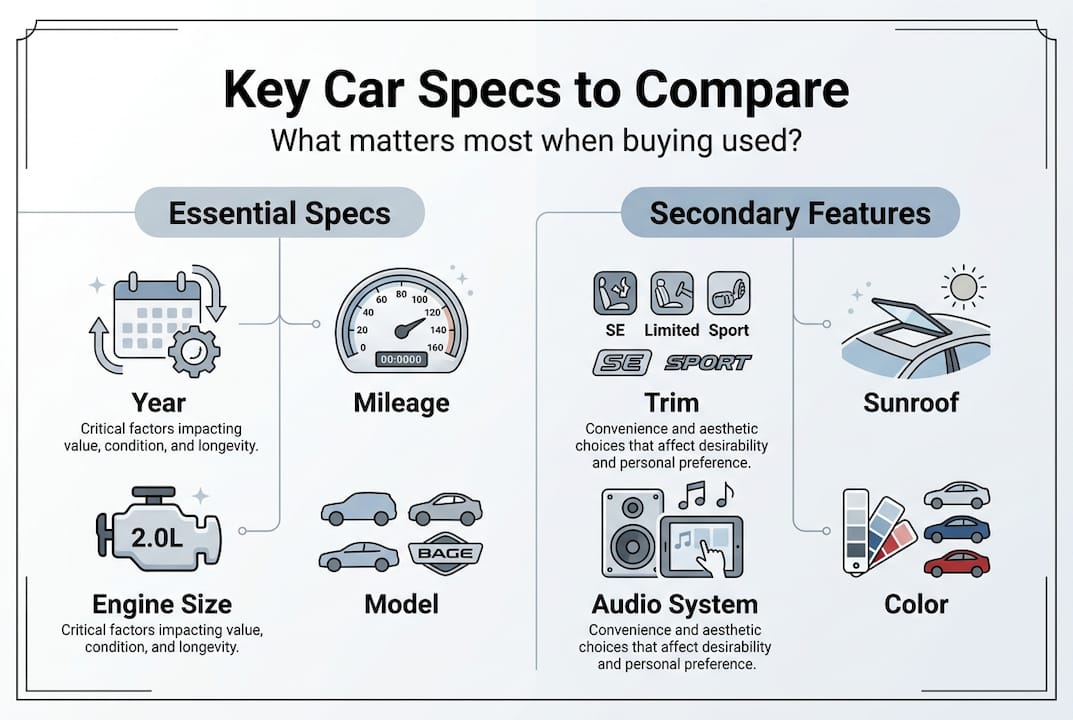
Model explains 87.6% of price variance in used car sales, with mileage and engine size rounding out the top influencing factors. That's a striking number. It means the specific model you choose matters more than almost anything else on the listing page.
Here are the four specs that deserve your closest attention:
- Model and trim level: The base model and its trim define the standard equipment, safety ratings, and long-term parts availability.
- Production year: Reflects generation updates, recall history, and depreciation curve.
- Engine size and type: Directly impacts performance, fuel economy, and repair costs.
- Mileage: Use it as a relative indicator, not an absolute one. A well-maintained car at 90,000 miles often beats a neglected one at 40,000.
To make this concrete, here's how two similar used cars might compare:
| Spec | Car A | Car B |
|---|---|---|
| Model | Honda Civic LX | Honda Civic EX |
| Year | 2019 | 2017 |
| Engine | 2.0L 4-cylinder | 1.5L turbocharged |
| Mileage | 62,000 | 48,000 |
| Asking price | $17,500 | $16,800 |
Car B has lower mileage, but Car A is two years newer with a simpler naturally aspirated engine that may be cheaper to maintain long-term. Neither is obviously better without digging deeper, but the spec comparison immediately surfaces the right questions to ask.

Pro Tip: Don't let eye-catching extras like a panoramic sunroof or premium audio system distract you from major spec differences. A newer year with a more reliable engine will serve you far longer than a loaded older model.
Always cross-reference specs with a solid vehicle history checklist and a thorough service history guide to validate what the numbers suggest.
Beyond the numbers: Combining specs with condition and history
Specs are a powerful filter, but they're not the full picture. A car can look perfect on paper and be a financial nightmare in practice. This is where many buyers make their biggest mistakes.
Over-reliance on specs risks missing critical condition issues and hidden history problems that no spec sheet will reveal. Rust hidden under a fresh paint job, a rebuilt title after a major accident, or a transmission that's been slipping for months won't show up in the engine displacement field.
Here's how a spec-perfect car can actually be riskier than a spec-average one:
| Factor | Spec-perfect car | Spec-average car |
|---|---|---|
| Year/mileage | 2021, 35,000 miles | 2019, 58,000 miles |
| Service records | None available | Complete dealer records |
| Inspection result | Rust, worn brakes | Clean bill of health |
| VIN history | Accident reported | Clean title, one owner |
| Real-world risk | High | Low |
The spec-average car is the smarter buy. Every time.
Here's what to combine with your spec analysis:
- VIN check: Reveals accident history, title status, and odometer discrepancies. Understanding VIN identity is a foundational step.
- Service records: A full maintenance paper trail is worth more than a shiny exterior.
- Pre-purchase inspection: Have a trusted mechanic inspect the car independently before you commit.
- Car record archives: Digging into car record archives can surface ownership patterns that flag red flags early.
Pro Tip: Always request maintenance documentation alongside the spec sheet. If a seller can't produce service records, treat that as a serious warning sign, not a minor inconvenience. Good digital car recordkeeping is increasingly common among responsible sellers.
How to apply car spec analysis for smarter purchases
Buyers who analyze model, year, engine size, and mileage consistently make smarter purchase decisions. But analysis only works when it's part of a structured process, not a last-minute checklist you run through at the dealership.
Here's a step-by-step workflow you can apply to any used car purchase:
- Gather specs first. Before visiting a car or contacting a seller, pull the full spec sheet. Use car finder tools to filter by the specs that matter most to you.
- Compare at least two options. Never evaluate a single car in isolation. Side-by-side comparison reveals value gaps and pricing inconsistencies.
- Check condition and history. Run a VIN check, request service records, and review any available inspection reports.
- Verify seller claims. Cross-reference what the seller tells you against the spec sheet and history report. Discrepancies are a red flag.
- Apply a car maintenance checklist during inspection. This ensures you're not missing mechanical issues that won't appear in any database.
Let's make this real. Imagine two 2020 Toyota Camry SE sedans, both with around 55,000 miles and 2.5L engines. On paper, they're nearly identical. But Car A has a full dealer service history, a clean VIN report, and passes a pre-purchase inspection. Car B has no service records, a minor accident on its VIN report, and shows uneven tire wear during inspection.
Car A is worth paying a premium for. Car B's lower asking price is a trap.
Before committing to any purchase, double-check these items:
- Title status (clean, salvage, rebuilt)
- Odometer consistency across VIN report and service records
- Recall status and whether open recalls have been addressed
- Tire condition and brake wear relative to mileage
- Any signs of fluid leaks or deferred maintenance
This workflow turns spec analysis from a passive exercise into an active buying advantage.
The expert viewpoint: What most buyers overlook in spec-based decisions
Here's the uncomfortable truth that most buying guides won't say directly: impressive specs can actually make buyers less careful. When a car checks all the boxes on paper, there's a psychological pull to stop investigating. That's exactly when you need to dig deeper.
We've seen buyers walk away from genuinely solid vehicles because the mileage looked high, while others overpaid for low-mileage cars with no service history and a questionable VIN report. Specs are a filter, not a verdict.
The savviest buyers use specs to narrow the field quickly, then shift their attention entirely to condition, history, and inspection results. Specs alone are not enough for a confident used car decision. The numbers tell you where to look. The inspection and records tell you what you're actually buying.
A strong history checklist used alongside spec analysis is the combination that separates confident buyers from hopeful ones. Build that habit before you ever make an offer.
Simplify your used car buying with AutoManual
Putting all of this into practice is a lot easier when your specs, records, and history are organized in one place. That's exactly what AutoManual is built for.
With AutoManual, you can scan your car profile using any VIN and instantly pull full technical specs, no signup required. It also works as a digital garage where you can track maintenance history, store documents, and manage multiple vehicles in one place. Whether you're evaluating a purchase or managing a collection, AutoManual gives you the organized, verified data you need to make confident decisions every time.
Frequently asked questions
Which car specs have the strongest impact on pricing?
Production year, model, engine size, and mileage are the most influential factors in used car pricing, with model alone accounting for 87.6% of price variance in some studies.
Should I rely only on car specs when buying used?
No. Over-reliance on specs risks overlooking critical condition issues and history problems, so always combine spec analysis with VIN checks, inspection reports, and service records.
How can I check a used car's specs accurately?
VIN decoding is one of the most reliable methods, giving you manufacturer-verified specs tied directly to the specific vehicle rather than a generic model listing.
Does prior ownership affect car value as much as specs?
Research shows prior ownership is far less significant than core specs like production year, model, and mileage when it comes to used car pricing.
What digital tools can help track car specs and records?
Platforms like AutoManual offer free VIN decoding and digital car profiles that centralize specs, maintenance history, and ownership documents for confident, organized buying decisions.