
TL;DR:
- Car record archives provide comprehensive vehicle histories beyond basic DMV documents.
- Combining government and commercial data sources offers the most complete vehicle background.
- Regular archive checks help prevent fraud and ensure accurate vehicle information for buyers and owners.
Most used car buyers assume that a clean title and a stack of paper receipts tell the full story. They don't. A car can have a rebuilt title, hidden flood damage, or a rolled-back odometer and still come with a tidy folder of documents. A car record archive is a comprehensive database that stores historical records on individual vehicles, pulling from sources far beyond what any single document can show. This guide breaks down exactly what these archives are, how they work, who runs them, and how you can use them to protect yourself whether you're buying, selling, or just managing a vehicle you already own.
Table of Contents
- What is a car record archive?
- Major car record archives: Commercial and governmental
- How car record archives collect and organize data
- Practical uses: Verifying, purchasing, and managing cars
- Why basic paperwork isn't enough: A deeper look
- Explore digital car profiles and secure your history
- Frequently asked questions
Key Takeaways
| Point | Details |
|---|---|
| Beyond basic DMV records | Car record archives reveal history far richer than simple registration or plate changes. |
| Provider coverage matters | Commercial archives and NMVTIS differ in scope and depth—knowing which to use is crucial. |
| Data accuracy evolves | Machine learning and reliable processes now increase confidence but double-checking is wise. |
| Practical benefits for buyers | Using archives prevents fraud, supports smart purchases, and protects vehicle value. |
| Digital profiles for the future | Modern solutions like AutoManual help owners maintain complete, accessible vehicle records. |
What is a car record archive?
A car record archive is not a filing cabinet at your local DMV. It's a structured, often massive database that aggregates detailed historical data on individual vehicles, going far beyond the basic registration and ownership transfers that a DMV file typically holds. Think of it as a vehicle's permanent report card, compiled from dozens of independent sources over its entire life.
Understanding car identity is the foundation here. Every vehicle has a 17-character VIN (Vehicle Identification Number) that acts as its unique fingerprint. Car record archives use this VIN as the primary key to link records from different sources into one coherent history.
Here's what a typical car record archive pulls together:
- Title and ownership transfers from state DMVs
- Accident and collision reports from police departments and insurers
- Odometer readings logged at inspections, sales, and service visits
- Salvage, flood, and lemon designations from insurance companies
- Auction records from dealer and wholesale channels
- Service and maintenance logs from repair shops and dealerships
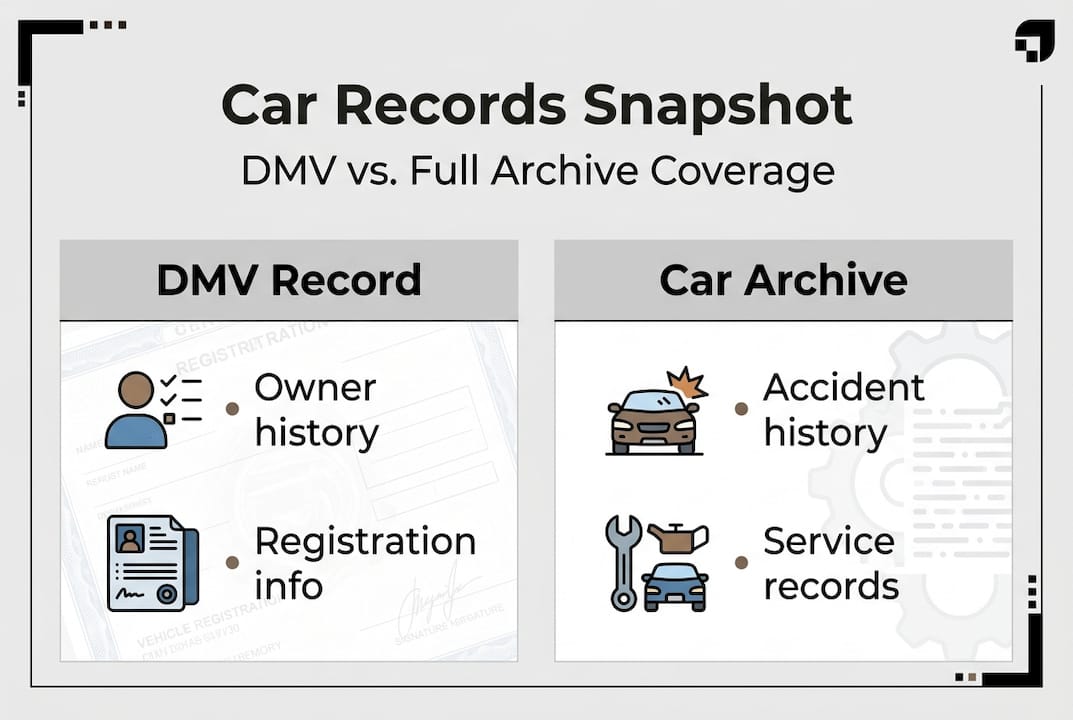
The key difference between a car record archive and a basic DMV vehicle record is depth and breadth. A DMV file tells you who registered the car and when. An archive tells you what happened to the car during every stage of its life.
| Data type | DMV record | Car record archive |
|---|---|---|
| Ownership history | Yes | Yes |
| Accident reports | No | Yes |
| Odometer fraud flags | Limited | Yes |
| Salvage/flood titles | Partial | Yes |
| Service records | No | Yes |
| Auction history | No | Yes |
Pro Tip: Not every vehicle document you receive from a seller is sourced from a full archive. A service receipt proves one visit happened. An archive proves a pattern, or reveals what's missing from the pattern.
Major car record archives: Commercial and governmental
Now that you understand what goes into a car record archive, it helps to know who actually runs them. There are two main categories: governmental and commercial.
The governmental backbone is NMVTIS (National Motor Vehicle Title Information System), managed by the U.S. Department of Justice and administered through AAMVA. It collects title, brand, and odometer data directly from state DMVs. NMVTIS covers roughly 81% of U.S. vehicles, which is solid but not complete. CARFAX and AutoCheck, the two dominant commercial providers, fill in the gaps by pulling from a much wider network of sources.
| Provider | Type | Record volume | Key data sources |
|---|---|---|---|
| NMVTIS | Governmental | State-level | DMVs, salvage yards, insurers |
| CARFAX | Commercial | 36+ billion records | DMVs, police, auctions, shops |
| AutoCheck | Commercial | Billions | DMVs, auctions, Experian data |
Commercial archives like CARFAX pull from police departments, independent repair shops, rental fleets, and auction houses. This gives them a richer, more granular picture. NMVTIS, by contrast, is authoritative on title status but thinner on day-to-day vehicle activity.
"Relying on one archive alone is like reading only the chapter titles of a book. You get the outline, but you miss the story."
For buyers, the practical advice is to use both. Check NMVTIS-based reports to confirm title status and branding, then use a commercial report to look for accident patterns, mileage inconsistencies, and service gaps. Our vehicle history checklist walks through exactly what to look for in each report type.
For owners, maintaining your own service history and keeping it documented is how you ensure your car's archive reflects its true condition when it's time to sell.
Key data sources that feed commercial archives include:
- State DMVs across all 50 states
- Law enforcement accident databases
- Insurance company total-loss and claim records
- Wholesale and retail auction platforms
- Franchise and independent repair shops
- Rental and fleet management companies
How car record archives collect and organize data
With providers compared, let's look at how these archives actually work under the hood. The process is more sophisticated than most people realize, and understanding it helps you interpret what you see in a report.
Here's how data flows from the real world into a car record archive:
- Data collection: Electronic feeds arrive daily from DMVs, insurers, auction houses, and repair networks. Some feeds are automated; others are submitted in batches.
- Normalization: Raw data arrives in hundreds of different formats. Archive systems standardize it so a mileage entry from a Texas DMV and one from a California smog check can be compared side by side.
- De-duplication: The same accident might be reported by a police department, an insurer, and a body shop. De-duplication logic merges these into a single event rather than inflating the record count.
- VIN matching: Every record is cross-referenced by VIN to attach it to the correct vehicle history.
- Predictive modeling: Machine learning algorithms analyze patterns. Mileage trends, regional usage data, and service intervals feed into reliability scoring models that estimate a vehicle's condition and flag anomalies.
The scale here is staggering. CARFAX alone processes billions of data points, with records updated continuously as new feeds arrive. That predictive layer is where archives have gotten genuinely impressive. If a car's mileage jumps backward between two records, or if a vehicle registered in a flood zone shows no service history for 18 months, the system flags it.
Pro Tip: Machine learning improves archive accuracy, but it's not infallible. A car repaired off the books at a private shop won't generate a record. Always cross-check archive findings with a pre-purchase inspection from a trusted mechanic.
For buyers, this means the predictive score in a report isn't just a marketing feature. It's a signal built from real data patterns. A low reliability score on a vehicle with otherwise clean paperwork is worth investigating seriously before you sign anything.
Practical uses: Verifying, purchasing, and managing cars
Once data is processed and organized, here's how you actually benefit from car record archives in day-to-day decisions.
For used car buyers, archives are your primary defense against fraud. Common scams include odometer rollback, title washing (moving a branded title across state lines to obscure its history), and selling flood-damaged vehicles as clean. A proper archive check catches all three. Using car finder tools alongside an archive report gives you a complete picture before you ever visit a dealership.
For current owners, tracking maintenance efficiently through a digital record means your car's archive reflects its true care history. This directly affects resale value. A buyer who can see consistent oil changes, brake jobs, and inspections in an archive report is far more likely to pay asking price.
Here are the most common mistakes people make with car record archives:
- Checking only one archive and assuming it's complete
- Skipping the archive check on a private sale because the seller seems trustworthy
- Ignoring gaps in service history as unimportant
- Failing to compare car models before narrowing down to a single option
- Not knowing how to find car specs to verify that the vehicle matches its listed configuration
Car record archives are essential for verifying authenticity and condition, tracking maintenance, and avoiding fraud. They're not optional due diligence. They're the baseline.
Pro Tip: Always run an archive check before buying and before selling. Knowing what's in your own vehicle's record lets you address issues proactively and price the car accurately.
For owners managing multiple vehicles, ownership tracking across a digital platform keeps all your records in one place, making it easy to pull a complete history whenever you need it.
Why basic paperwork isn't enough: A deeper look
Here's an uncomfortable truth most buyers learn the hard way: a clean title is not a guarantee of a clean history. State DMV records offer limited scope and are not substitutes for full vehicle histories. They record ownership. They don't record what happened to the car between owners.
We've seen cases where vehicles with three prior insurance total-loss events were sold with clean titles because each event occurred in a different state, and the title branding never followed the car across state lines. Paper documents from the seller showed regular maintenance. The archive told a completely different story.
The uncomfortable reality is that sophisticated sellers know exactly which gaps exist in the system. They exploit the lag between an event and its appearance in a database, or they target buyers who won't think to check a full archive. Relying on a history checklist for buyers that includes archive verification is how you close those gaps.
Archives aren't perfect. But they're the closest thing to an objective, third-party witness to a vehicle's life. Paper documents are easy to fabricate. A consistent archive record across multiple independent sources is not.
Explore digital car profiles and secure your history
Understanding car record archives is one thing. Having instant access to your own vehicle's full picture is another.
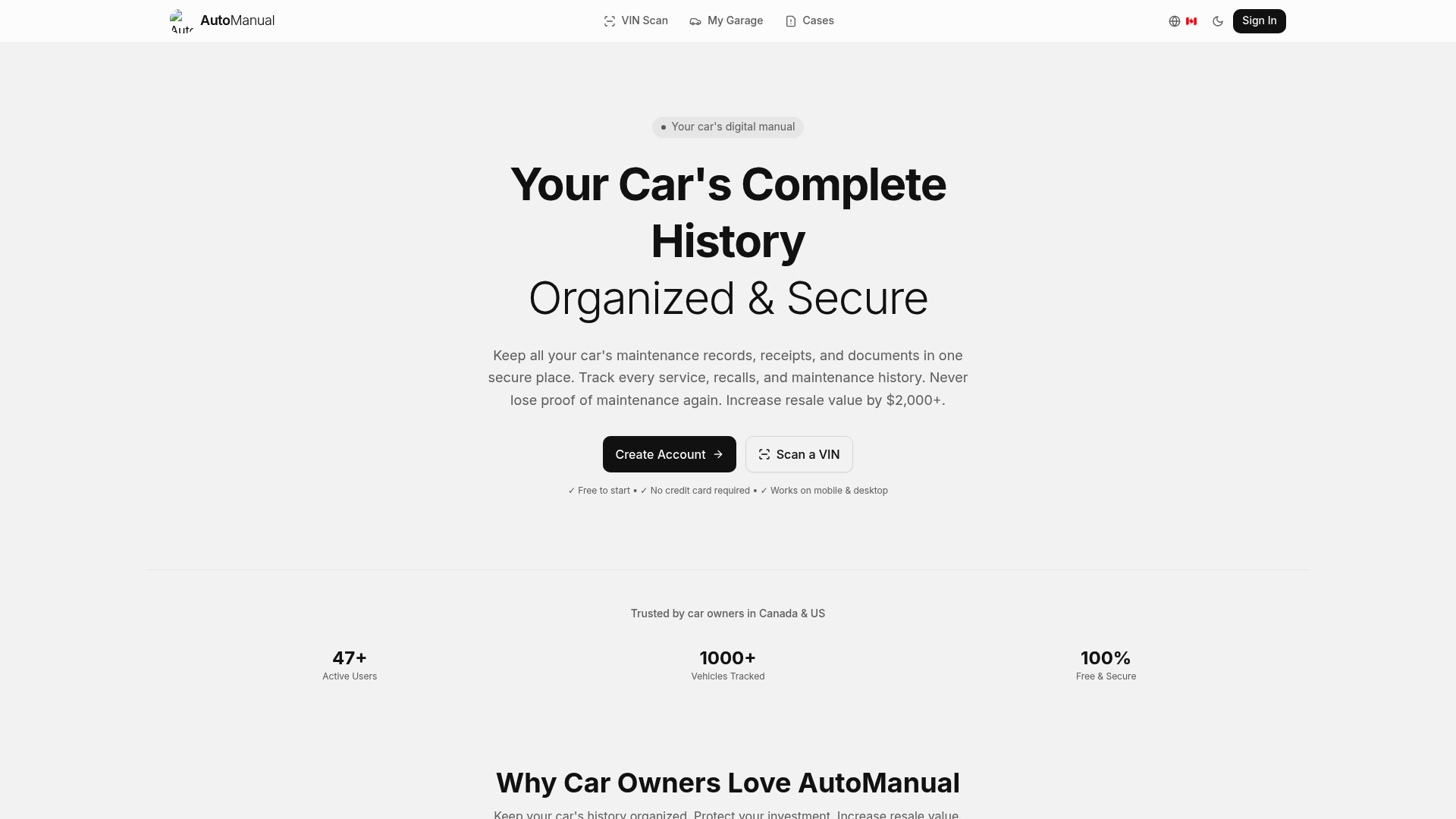
AutoManual makes it simple. Run a free digital car scan using any VIN and get full technical specs instantly, no account required. For owners who want to go further, a digital car profile lets you store your maintenance records, documents, and ownership details in one organized place. Whether you're buying your next car or managing the ones you already own, AutoManual gives you the transparency and control that paper documents never could. Your vehicle's history should work for you, not against you.
Frequently asked questions
How is a car record archive different from a DMV vehicle record?
DMV records cover basic registration and plate history only, while a car record archive includes accidents, odometer data, service logs, and title brands compiled from dozens of independent sources.
Can I access a car record archive for any vehicle?
Most vehicles can be checked through commercial services or NMVTIS, though NMVTIS covers roughly 81% of U.S. vehicles, meaning some older or rare models may have incomplete coverage.
How accurate are car record archives?
Accuracy has improved significantly with electronic data feeds and predictive modeling, but off-the-books repairs and private transactions can still leave gaps, so always verify with a physical inspection.
What information can I expect from a car record archive?
A full report typically includes accident history, title brands, odometer readings, ownership transfers, and service records, all compiled from DMVs, police, insurers, auctions, and repair shops.