

TL;DR:
- Maintenance history provides crucial insight into a car’s care and reliability beyond mileage.
- Missing or incomplete records can reduce a vehicle's value by up to 40%, especially for luxury cars.
- Verifying records through receipts, VIN checks, and mechanic inquiries helps assess true condition.
Nearly 37% of used car buyers skip checking service history before signing the paperwork. That single oversight can cost thousands in surprise repairs, wipe out resale value, and leave you with a car that looks fine on the outside but is quietly falling apart inside. Maintenance history is the closest thing you have to a car's medical record, and ignoring it is like buying a house without an inspection. This guide breaks down what service records actually tell you, how missing records affect what you pay, how to verify what you're given, and when gaps are genuinely acceptable versus when they're a serious warning sign.
Table of Contents
- What is maintenance history, and why does it matter?
- How missing or incomplete service records affect car value
- How to verify and interpret maintenance history
- Special cases: When missing history isn't a dealbreaker
- Our perspective: What most experts miss about maintenance history
- Ready to track or verify your car's history?
- Frequently asked questions
Key Takeaways
| Point | Details |
|---|---|
| Maintenance beats mileage | A well-documented service history can predict reliability more than just looking at the odometer. |
| Value drops without records | Missing or incomplete history can reduce a car’s resale value by 5–40%. |
| Verification is critical | Always ask for and review maintenance records, using VIN and mechanic checks for extra confidence. |
| Exceptions exist | For budget or older cars, a clear inspection may outweigh the risk of missing history. |
| Digital tools help | Modern recordkeeping and car profile platforms make it easier to track and protect car value. |
What is maintenance history, and why does it matter?
Maintenance history is the complete paper or digital trail of every service, repair, and inspection a vehicle has received. Think of it as a running log of how a previous owner treated the car. It goes well beyond just oil changes. A thorough record set includes brake jobs, tire rotations, fluid flushes, timing belt replacements, recall completions, and notes from mechanics about anything flagged during routine visits.
Here's what you'll typically find in a solid maintenance record:
- Oil and filter change dates and mileage intervals
- Brake pad and rotor replacements
- Timing belt or timing chain service
- Transmission fluid and coolant flushes
- Tire purchases and rotation history
- Recall notices and confirmation of completion
- Inspection reports with mechanic notes
- Battery replacements
Now, most buyers focus on the odometer. Low miles feels safe. High miles feels risky. But that logic breaks down fast in the real world. A car with 120,000 miles that has been serviced on schedule, with every receipt saved, is almost always a smarter buy than a 60,000-mile car whose owner skipped oil changes for years and never touched the brakes.
Maintenance records reveal real care, often indicating reliability better than mileage alone.
Mileage only tells you how far a car has traveled. Records tell you how well it was cared for along the way. A well-documented history shows patterns: consistent intervals, the same trusted shop, proactive repairs rather than reactive ones. Those patterns predict future reliability far better than a single number on a dashboard.
When you review a vehicle history checklist before buying, you're not just being cautious. You're gathering the evidence you need to negotiate fairly, budget for upcoming maintenance, and avoid cars that are one breakdown away from a major bill. Pairing that with car specs for buying gives you the full picture of what you're actually purchasing.
How missing or incomplete service records affect car value
Service history isn't just about reliability. It directly affects how much a car is worth, both when you buy it and when you eventually sell it. The financial impact is bigger than most buyers expect.

Missing history can reduce value by 5 to 15% for standard vehicles, and up to 40% for premium or luxury cars. That's not a small number. On a $25,000 vehicle, a 15% discount sounds great until you realize you're also inheriting unknown maintenance debt.
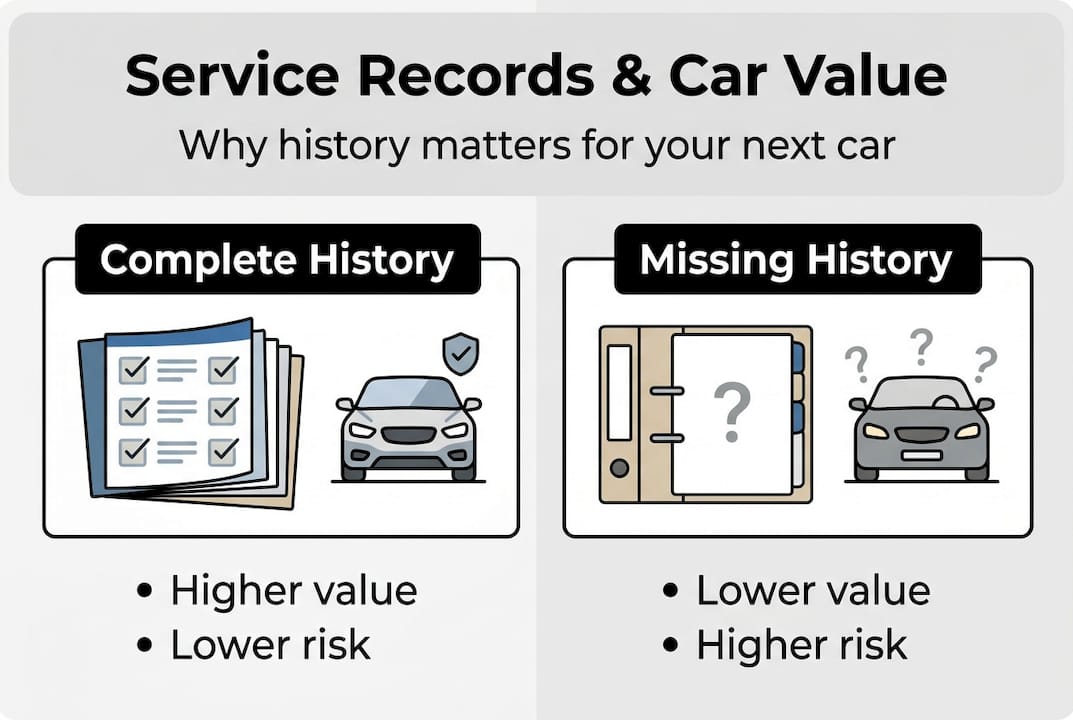
| Record status | Typical value impact | Risk level |
|---|---|---|
| Full documented history | Baseline or premium value | Low |
| Partial records (some gaps) | 5 to 10% below baseline | Moderate |
| Missing history entirely | 10 to 40% below baseline | High |
The table above shows why sellers with complete records can and do ask for more money. Buyers who skip this check often overpay for a car that's already been neglected, then face repair bills that eat through any perceived savings within the first year.
It's worth repeating: 37% of buyers skip this check entirely. That means a significant portion of used car buyers are walking into negotiations blind, with no leverage and no way to assess true condition.
Pro Tip: Even partial records are better than none. A car with three years of documented service followed by a two-year gap tells a more useful story than zero records. Always investigate what caused the gap before dismissing the car entirely.
If you want to protect your investment long-term, learning how to maximize resale value starts the moment you buy. And if you're already an owner, knowing why you should track car maintenance consistently will pay off when it's time to sell.
How to verify and interpret maintenance history
Getting records from a seller is one thing. Knowing how to read and verify them is another. Here's a practical process you can follow before committing to any used car purchase.
- Request all physical records upfront. Ask the seller for every receipt, invoice, and service booklet before you even schedule a test drive. Reluctance to share is itself a red flag.
- Run a VIN report. A VIN check pulls reported accidents, title history, odometer readings, and sometimes dealer-logged service events. It won't catch everything, but it catches a lot.
- Cross-reference receipts with odometer readings. The mileage on each receipt should increase logically over time. Inconsistencies suggest tampering or missing records.
- Contact the servicing shops directly. If receipts show a specific garage or dealership, call them. Many shops keep records for years and can confirm or fill in gaps.
- Evaluate digital service logs. Some manufacturers maintain digital car recordkeeping systems tied to the VIN. These are harder to fake and often more complete than paper records.
- Get a pre-purchase inspection. A trusted mechanic can spot deferred maintenance, worn components, and signs of neglect that no paperwork will reveal.
Knowing what to look for in car record archives helps you spot patterns that sellers may not volunteer. Watch for these red flags:
- Gaps of more than two years with no explanation
- Odometer readings that don't increase consistently between services
- All stamps written in the same handwriting (possible forgery)
- Only DIY or undocumented work with no professional receipts
- Records that start recent but show nothing from the car's earlier years
Pro Tip: Always pair a history check with an independent pre-purchase inspection. Prioritize VIN reports, seller receipts, and dealer logs and flag inconsistent mileage or suspicious gaps before spending a dollar.
Special cases: When missing history isn't a dealbreaker
Not every situation is black and white. Context matters enormously when evaluating incomplete records.
For older, high-mileage, or budget-priced vehicles, missing paperwork is common and doesn't automatically mean the car is a bad buy. A 15-year-old economy car with 180,000 miles may have changed hands multiple times, and expecting a full paper trail is unrealistic. What matters more in that scenario is the current condition, confirmed by a thorough inspection.
High-mileage but well-serviced cars are often safer bets than low-mileage neglected ones, and cheap cars with no records can be acceptable after a solid inspection.
| Scenario | Missing history risk | Recommended action |
|---|---|---|
| Budget car under $5,000, older model | Lower risk | Inspection required, price accordingly |
| Mid-range car $10,000 to $20,000 | Moderate risk | Partial records plus inspection minimum |
| Premium or luxury car over $30,000 | High risk | Full history required, walk away if absent |
| Recent model under 5 years old | High risk | Demand full dealer or digital records |
Partial history is better than none, and pairing it with a pre-purchase inspection often provides enough confidence for budget-range purchases.
However, there are situations where you should never skip full history verification:
- Premium, luxury, or performance vehicles where deferred maintenance is expensive
- Cars you plan to finance, since lenders may require documented condition
- Vehicles you intend to resell, since you'll face the same scrutiny from your future buyer
- Any car where the seller is evasive or changes their story about service
Using a solid maintenance checklist during your evaluation helps you cover the gaps that records can't fill.
Our perspective: What most experts miss about maintenance history
Most buying guides treat a complete service history as the gold standard, and walk away from anything less. We think that's too rigid for most everyday buyers.
Chasing perfect records can actually distract you from what matters: the car in front of you. A buyer who spends all their energy hunting for a full paper trail may overlook a mechanically sound vehicle with minor documentation gaps, while passing up real value. Minor gaps often reflect lost paperwork or a move between states, not neglect.
The premium and luxury market is different. Incomplete records genuinely punish resale value there, and the cost of deferred maintenance on a European luxury car can be brutal. But for regular commuter cars, the smartest approach blends common sense, a thorough inspection, and honest price negotiation based on what the records do and don't show.
Use the history checklist for buyers as a framework, not a pass/fail test. The goal is to understand what you're buying, not to find a perfect document set.
Ready to track or verify your car's history?
With these strategies in hand, the next step is putting them to work before your next purchase or sale.
AutoManual makes it easy to check any vehicle's specs and history instantly. Just enter a VIN at automanual.vin and get full technical details with no signup required. If you already own a car, use the digital garage to store your maintenance records, documents, and ownership details all in one place. Buyers and sellers both benefit when records are organized and accessible. Scan your car profile today and see exactly what your vehicle's history looks like, so you're never caught off guard at the negotiating table or the mechanic's shop.
Frequently asked questions
What is included in a car's maintenance history?
It typically covers routine services, repairs, part replacements, recalls, and sometimes inspection notes from mechanics. Oil changes, brake service, and timing belt work are among the most common entries.
How much value does missing service history really cost?
Cars without full service history may lose 5 to 15% of their value, and sometimes up to 40% for premium vehicles. That gap compounds when you factor in unknown repair costs.
Can I trust handwritten or DIY maintenance records?
Handwritten or DIY records may signal gaps or be less reliable; verify patterns and prefer official receipts or digital logs. Same-handwriting stamps across multiple service entries are a common red flag.
Is it ever safe to buy a car without any maintenance history?
For cheap or very old cars, a clean inspection can compensate for missing records, but always avoid large purchases without any history. The higher the price, the more history you should demand.
Should I pay more for a car with complete service records?
Yes. A car with a full history is worth a premium, especially for newer or luxury models, because full history cars sell for 10 to 40% more and signal better care and lower future risk.