

TL;DR:
- Warranties generally cover defects in materials and workmanship, not routine maintenance or wear items.
- Proper maintenance documentation and understanding warranty exclusions are crucial for claim approval.
- Using independent repair shops and tracking vehicle history helps preserve warranty coverage and resolve disputes.
Most car owners treat their warranty like a safety blanket, assuming it covers any breakdown that comes their way. That assumption can be expensive. The reality is that warranties come with layered exclusions, state-specific rules, and fine print that can leave you holding a repair bill you never expected. Whether you just bought a used car or you're trying to protect a vehicle you've owned for years, understanding exactly what your warranty covers, what it excludes, and how your own behavior affects it is the difference between a covered repair and a denied claim.
Table of Contents
- What car warranties do (and don't) cover-cover)
- Decoding implied, statutory, and extended warranties
- How maintenance and repairs affect your warranty
- Navigating denials, disputes, and 'edge cases'
- Our take: Why most car owners overlook warranty fine print
- Track your warranty and maintenance with AutoManual
- Frequently asked questions
Key Takeaways
| Point | Details |
|---|---|
| Coverage varies by terms | Not all warranties cover the same parts; exclusions are common and knowing the details is vital. |
| State laws matter | Implied, statutory, and lemon law protections differ depending on location and mileage. |
| Maintenance records are essential | Detailed service history can prevent warranty denials and make claims easy. |
| Independent repairs are allowed | You do not need dealership service to keep your warranty valid if repairs are done properly. |
| Modifications can void coverage | Racing, aftermarket parts, and failing to document services may lead to denied claims. |
What car warranties do (and don't) cover
After seeing why understanding warranty terms is critical, let's start by clarifying what warranties actually cover.
A standard manufacturer's warranty, often called a bumper-to-bumper warranty, covers defects in materials and workmanship. That means if a part fails because it was made incorrectly or malfunctions without outside cause, the manufacturer pays for the fix. Powertrain warranties go a step further and specifically protect the engine, transmission, and drivetrain components for a longer period, sometimes up to 10 years or 100,000 miles depending on the brand.
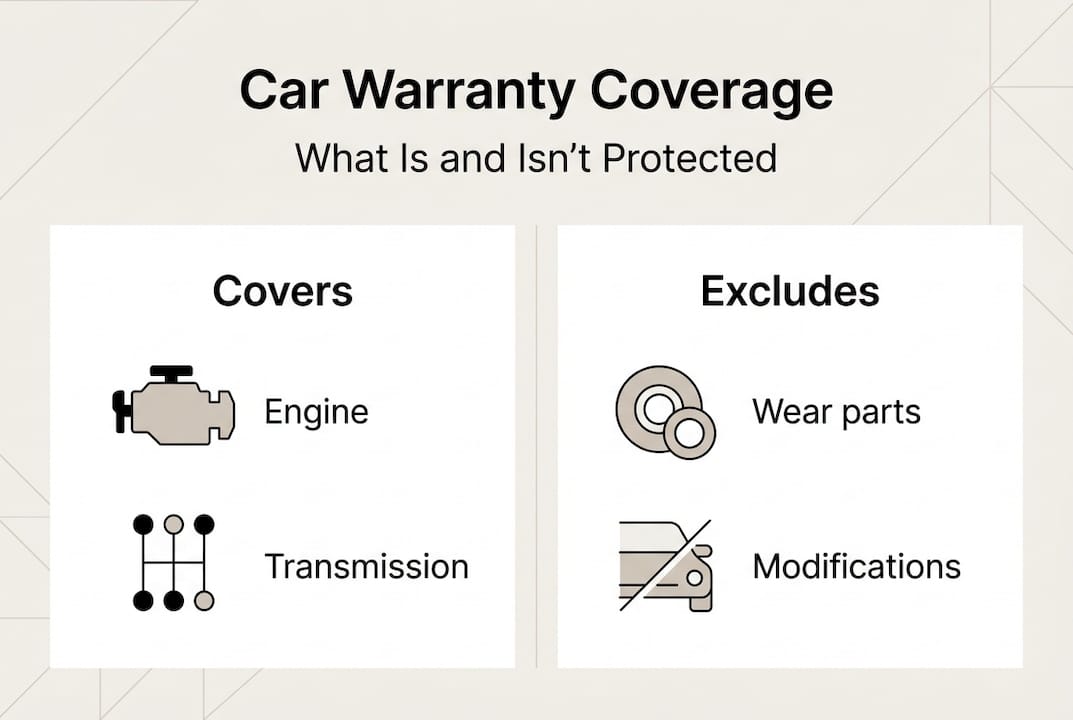
But here's where most people get tripped up. Warranties are not insurance policies. They do not cover everything that goes wrong with your car.
Common warranty exclusions include:
- Normal wear and tear items: brakes, tires, batteries, and wipers
- Damage from accidents, floods, or fire
- Misuse or abuse, such as overloading or off-road driving beyond the vehicle's design
- Modifications to the vehicle, including aftermarket parts
- Routine maintenance tasks like oil changes, filter replacements, and fluid top-offs
The FTC confirms that normal wear and tear, accidents, misuse, modifications, and routine maintenance are standard exclusions across most auto warranties. This matters because repairs outside warranty coverage can run into thousands of dollars. A brake job alone can cost $300 to $800 per axle at a dealership.
| What's typically covered | What's typically excluded |
|---|---|
| Engine and transmission defects | Brake pads and rotors |
| Electrical system failures | Tires and wheels |
| Factory-installed components | Battery replacement |
| Steering and suspension defects | Wiper blades |
| Air conditioning system failures | Oil changes and filters |
Understanding the difference between a defect and normal degradation is key. A transmission that slips because of a manufacturing flaw is covered. A transmission that fails because you never changed the fluid is not. Staying current on car maintenance types is one of the most practical ways to keep your warranty intact and your car running well.
"Warranties are not a substitute for regular maintenance. Owners are responsible for keeping up with scheduled service to preserve coverage." — FTC consumer guidance
Decoding implied, statutory, and extended warranties
With the basic coverage and exclusions clear, let's demystify the different types of warranties and how state laws come into play.
Not all warranties are created equal, and not all of them come in a printed booklet from the manufacturer. There are three main types you'll encounter as a buyer or owner.
1. Implied warranties are automatic legal protections that exist even if nothing is written down. When a dealer sells you a car, there's an implied warranty of merchantability, meaning the car should work for its basic purpose: driving. These vary by state and can sometimes be disclaimed by dealers using "as-is" language.
2. Statutory warranties are dealer-backed minimum protections required by state law for used car sales. New York, for example, requires dealers to provide warranties of up to 90 days or 4,000 miles for vehicles with fewer than 36,000 miles. Massachusetts uses a tiered system based on mileage at the time of sale. These state-required protections give used car buyers a meaningful floor of coverage that many don't realize they have.
3. Extended warranties (also called vehicle service contracts) are purchased separately, either through the dealer or a third-party provider. They extend coverage beyond the manufacturer's original terms. Read these contracts carefully because coverage, deductibles, and exclusions vary widely.
Lemon laws add another layer. These laws primarily protect new car buyers when a vehicle has a defect that cannot be fixed after a reasonable number of attempts. Some states, including California, New York, and Massachusetts, extend lemon law protections to used cars under certain conditions. Typically, you need to show multiple failed repair attempts or that the car was out of service for an excessive number of days.
Knowing the specs and history of a used car before you buy helps you understand what warranty tier applies. Checking used car specs and running through a vehicle history checklist before signing anything is a smart move.
| State | Used car statutory warranty | Lemon law for used cars |
|---|---|---|
| New York | Up to 90 days / 4,000 miles | Yes, under Used Car Lemon Law |
| Massachusetts | Tiered by mileage | Yes, limited |
| California | Implied warranty applies | Yes, for certified used cars |
| Texas | As-is sales allowed | Limited |
How maintenance and repairs affect your warranty
Understanding the forms of warranty is step one, but maintaining and repairing your car correctly is just as important for keeping your coverage intact.
One of the most persistent myths about car warranties is that you must take your vehicle to the dealership for every oil change and service appointment. This is simply not true. The FTC is clear that you can use independent repair shops without voiding your warranty, as long as the work performed does not cause damage to the vehicle. Dealers cannot legally require you to use their service department for routine maintenance.

That said, how you maintain your car absolutely affects your warranty eligibility.
Maintenance tasks that protect your warranty:
- Regular oil and filter changes per the manufacturer's schedule
- Coolant flushes and fluid checks
- Tire rotations and brake inspections
- Air filter replacements
- Keeping all service receipts and records organized
Pro Tip: Keep a dedicated folder, physical or digital, with every service receipt, repair invoice, and parts purchase. If a claim is ever denied, your records are your best defense. A car maintenance checklist makes it easier to stay on top of what's due and when.
Modifications are where things get complicated. Installing a lift kit, a performance exhaust, or an aftermarket engine tune can void coverage for related components. The key word is "related." A dealer cannot void your entire warranty because you installed aftermarket floor mats. But if you add a turbo kit and your engine fails, expect a fight. Digital maintenance tracking helps you document what was done, when, and by whom, which is essential if a dispute comes up.
Your service history also matters when you eventually sell. A well-documented car commands higher resale value and gives buyers confidence in the vehicle's condition.
Navigating denials, disputes, and 'edge cases'
Even with careful maintenance, warranty disputes can arise. Here's how to protect yourself and handle tough cases.
A denied warranty claim doesn't have to be the final word. Many denials are based on incomplete information or assumptions that can be challenged with the right documentation.
Steps to challenge a denied claim:
- Request the denial in writing with a specific reason
- Gather all your maintenance records and service receipts
- Get an independent mechanic's opinion on the cause of failure
- Contact the manufacturer's customer service directly, not just the dealer
- File a complaint with your state attorney general or the FTC if needed
The most common triggers for denials are modifications, missing records, and edge-case scenarios. Aftermarket parts and racing activity are two of the fastest ways to lose coverage. Even something like using your truck for towing beyond its rated capacity can be used to deny a drivetrain claim.
Pro Tip: Before installing any modification, check your warranty terms to see if it affects related components. Document every mod with photos, receipts, and dates. This creates a clear record that shows what was changed and when.
Dispute resolution resources:
- Your state's attorney general consumer protection office
- The FTC's consumer complaint portal
- The Better Business Bureau for dealer disputes
- Small claims court for lower-dollar disagreements
- Manufacturer arbitration programs (often required before litigation)
Checking maintenance history before buying a used car also helps you avoid inheriting someone else's warranty problems. If the previous owner modified the car or skipped service, that history follows the vehicle. Use car spec verification to confirm what you're actually buying. And if you want to understand the long-term value of keeping records, tracking maintenance benefits goes deeper into why it pays off.
Our take: Why most car owners overlook warranty fine print
Having tackled dispute strategies, let's reflect on what most buyers and owners miss about car warranty terms.
Conventional wisdom says a warranty is a safety net. Buy the car, keep the paperwork, and you're covered. But that framing is exactly why so many people end up blindsided by a denied claim.
The uncomfortable truth is that most warranty denials aren't the result of bad faith from manufacturers. They're the result of owners who never read the exclusions, skipped a few oil changes, or assumed their modification wouldn't matter. Warranties are contracts, and contracts have conditions.
What we've seen consistently is that the owners who never face warranty headaches are the ones who treat their documentation like it's as valuable as the car itself. They keep receipts. They log every service. They use tools like digital recordkeeping to build a clear, timestamped history of their vehicle's care.
Knowing your warranty terms isn't just about avoiding disputes. It's about making smarter decisions from the moment you buy. If you understand what's excluded, you can budget for those costs separately instead of being caught off guard.
Track your warranty and maintenance with AutoManual
If you want to avoid the headache of warranty disputes and make claims easier, here's how to get started.
Keeping your warranty valid comes down to one thing: proof. Proof that you maintained the car, proof that you didn't cause the damage, and proof that you followed the manufacturer's guidelines. AutoManual makes that proof easy to build and store.
With AutoManual's digital car profile, you can store your maintenance records, service history, and vehicle documents all in one place. No more digging through glove boxes or chasing down old receipts. When you scan your VIN, you instantly pull up full technical specs and can start building your vehicle's digital history from day one. It's free, requires no signup, and gives you the organized record that warranty disputes demand.
Frequently asked questions
What does a basic car warranty usually cover?
Basic warranties typically cover defects in the engine, transmission, and mechanical systems. Normal wear items like brakes, tires, and batteries are excluded, as are accidents and routine maintenance.
Do I have to use the dealer for maintenance to keep my warranty valid?
No. You can use independent repair shops as long as their work doesn't cause damage to the vehicle. The FTC confirms that dealer service is not required to maintain warranty validity.
How do state laws affect used car warranties?
State laws sometimes require minimum warranties for used cars sold by dealers. For example, New York and Massachusetts mandate statutory warranties based on mileage, and some states extend lemon law protections to used vehicles.
What can void my car warranty?
Modifications, racing, using incompatible aftermarket parts, or failing to keep maintenance records can all void coverage. Tracking these details carefully gives you the best chance of defending a claim if it's disputed.