

TL;DR:
- Car options are deliberate add-ons that influence vehicle value, resale, and ownership experience.
- Standard features are included in base models, while options are optional upgrades or packages.
- Choosing high-demand options wisely and verifying them helps optimize long-term value and satisfaction.
Two cars roll off the same assembly line, same make, same model, same year. One sells for $4,000 more than the other. The difference? Options. Car options are factory-installed or dealer-added features beyond a vehicle's base configuration, and they quietly shape everything from your daily driving experience to your car's long-term resale value. Most buyers treat options as a vague bonus, something listed in fine print they skim past. That's a costly mistake. This guide breaks down what car options actually are, how to tell them apart from standard features, and how to choose them in ways that genuinely serve your needs and budget.
Table of Contents
- What are car options and why do they matter?
- Standard features vs. options: Key differences explained
- Types of car options: Packages, standalone, and aftermarket
- How to choose car options wisely when buying
- Expert perspective: What most car buyers overlook about options
- Keep track of your car's options effortlessly
- Frequently asked questions
Key Takeaways
| Point | Details |
|---|---|
| Car options defined | Options are customizable features that enhance a vehicle beyond its standard setup. |
| Value and impact | The right options can improve your driving experience and car's resale value. |
| Types of options | Options include factory packages, standalone features, and aftermarket upgrades. |
| Choosing wisely | Focus on options that fit your needs and budget—avoid over-customizing. |
| Documentation matters | Always verify and record your car's options for accurate maintenance and sale. |
What are car options and why do they matter?
Car options are features that a buyer can add to a vehicle beyond what the manufacturer includes as standard equipment. Think of the base model as the foundation. Options let you build on top of it, choosing what fits your lifestyle. A sunroof, adaptive cruise control, heated seats, a premium Bose audio system, or a towing package are all examples of options that can be selected during purchase.
The critical thing to understand is that options are not random. They are deliberate choices that affect three things in measurable ways: the sticker price, the ownership experience, and the resale value down the road. Car options increase vehicle value and tailor the car to individual preferences, which means they can either attract or repel future buyers depending on what was chosen.
Here's what options commonly include:
- Safety technology: Blind-spot monitoring, lane-keep assist, automatic emergency braking
- Comfort features: Ventilated seats, panoramic sunroof, dual-zone climate control
- Technology upgrades: Navigation systems, wireless Apple CarPlay, heads-up display
- Performance additions: Sport-tuned suspension, larger brake packages, upgraded engine variants
- Aesthetic choices: Two-tone paint, chrome trim packages, specific alloy wheel designs
For buyers, knowing a car's exact options matters before signing anything. For sellers, accurately listing options can be the difference between a fast, profitable sale and weeks of low offers. That's why understanding car specs and value before you buy or sell is not optional. It's foundational.
"Buyers who verify options before purchase consistently make better deals and avoid post-sale surprises."
One often-overlooked issue: many used car listings are vague or inaccurate about options. A seller may honestly believe their car has factory navigation when it is actually an aftermarket unit, or may not realize a feature they use daily was a $2,000 add-on that buyers will pay for. Good car records and documentation solve this. Knowing how to find and verify options is one of the highest-leverage skills you can develop as a car buyer.
Standard features vs. options: Key differences explained
Every car comes with standard features, things that are included in every vehicle at that trim level regardless of what the buyer selects. Options are layered on top. Sounds simple, but the line blurs constantly, especially between different trim levels of the same model.
Take backup cameras. On a base Toyota Corolla, this is now a federal requirement in the U.S. and a standard feature. On a 2015 Honda Civic, it might have been an option. On a luxury BMW 3 Series from the same era, it came standard. The same feature shifts categories depending on make, model, year, and trim. Understanding feature types is essential for accurate car comparisons.
Here is a quick comparison to make this concrete:
| Feature | Standard (base trim) | Available as option | Notes |
|---|---|---|---|
| Air conditioning | Rarely on entry-level | Common mid-range add-on | Now standard on most cars |
| Leather seats | Usually premium trims | Option on mid trims | Affects resale significantly |
| Heated steering wheel | Rarely standard | Common package option | Popular in cold climates |
| Apple CarPlay | Becoming more standard | Still an option on older models | Adds tech value |
| Sunroof/moonroof | Mostly premium standard | Big mid-range option | One of the highest-demand options |
How to read a car listing for feature types:
- Look for the specific trim level first (LX, EX, Sport, Touring, etc.)
- Cross-reference that trim's standard equipment against the features listed
- Check the original window sticker or build sheet if available
- Use a VIN decoder to pull factory-installed option codes
- Ask for any documentation showing the original purchase price and option breakdown
One of the most common buyer mistakes is assuming a feature is standard when it was an expensive option, and then feeling robbed when the next car they look at doesn't have it at the same price. The flip side is equally dangerous: a seller inflating their price because of options that are standard on competing models.
Pro Tip: Before comparing car models, always verify whether each feature you care about is standard or optional on each vehicle. Two cars priced identically can have wildly different feature sets depending on factory options. Don't skip this step, even for car maintenance basics where certain features affect service requirements.
Types of car options: Packages, standalone, and aftermarket
Not all options work the same way. Understanding how they are structured helps you shop more strategically and avoid paying more than you should.
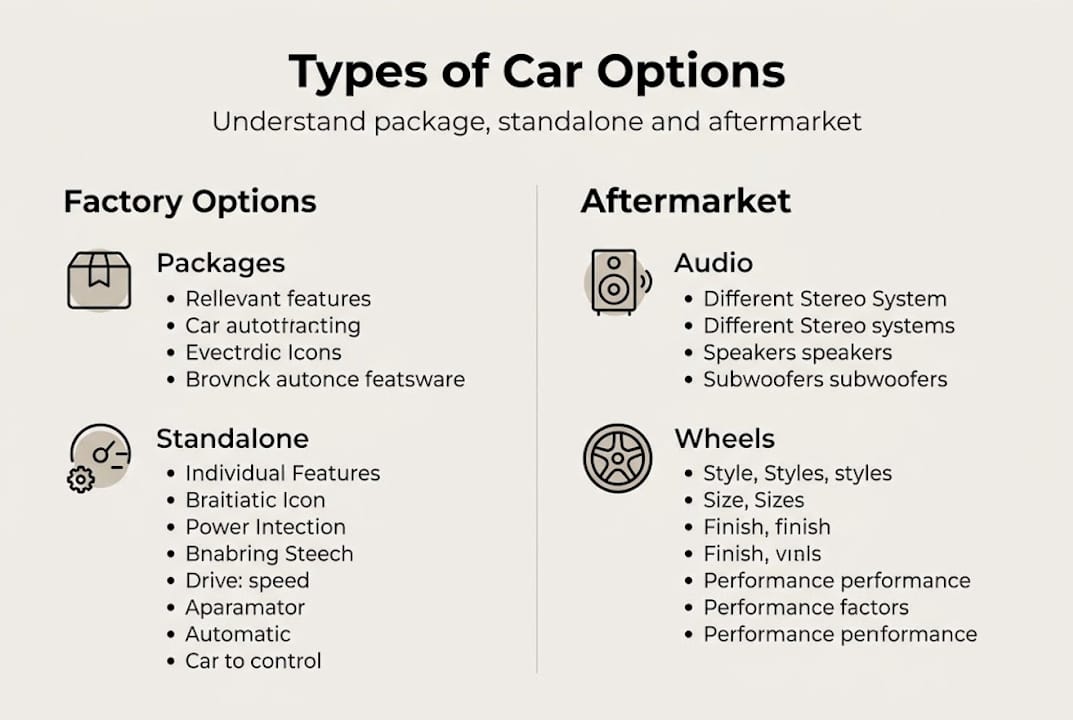
Option packages bundle multiple features together under one price. A "Technology Package" might include navigation, a larger touchscreen, wireless charging, and a heads-up display. A "Cold Weather Package" could group heated seats, a heated steering wheel, and heated mirrors. The advantage: packages often provide better value than buying single options, because manufacturers price them with a built-in discount versus selecting each item individually.

Standalone options are individual features added without a bundle. You might choose just a sunroof, or just a towing hitch receiver, without triggering any package. These can be useful if you only want one or two specific features, but they are often priced higher per item than they would be inside a package.
Aftermarket upgrades are not factory options. They are modifications added after the vehicle left the manufacturer. A remote start installed at a dealership after purchase, a custom exhaust, or an upgraded infotainment unit all fall into this category. Here's the important distinction: aftermarket modifications rarely add equivalent resale value compared to factory options. Some even reduce value if done poorly.
Here's a breakdown of how each type typically affects the vehicle:
| Option type | Source | Resale impact | Documentation |
|---|---|---|---|
| Package option | Factory/dealer | High (well-documented) | Window sticker, VIN codes |
| Standalone option | Factory/dealer | Medium to high | Build sheet, VIN codes |
| Dealer-installed | Dealership post-sale | Low to medium | Separate invoice |
| Aftermarket | Third party | Low or negative | No VIN record |
Spotting meaningful upgrades takes a trained eye. Look for:
- Consistent branding and fit (factory options look seamless)
- OEM part numbers on components
- Option codes visible in the VIN decoder results
- Clean, professional installation with no visible wiring hacks
Pro Tip: When verifying car options on a used vehicle, always cross-check the physical features against the VIN option codes. A seller might claim factory navigation, but the VIN will tell you the truth. Reviewing the vehicle history report alongside the option codes gives you the full picture.
How to choose car options wisely when buying
Knowing what options exist is half the battle. The other half is knowing which ones to actually choose without blowing your budget or hurting your resale value later.
Start with need, not want. It sounds obvious, but showrooms are designed to make you feel like you need everything. Careful selection of car options saves money and increases satisfaction over the long term. Write down your non-negotiables before you walk onto a lot or click through an online listing.
Here's a step-by-step approach to choosing options wisely:
- List your must-haves. Safety features like blind-spot monitoring or automatic braking? Comfort features for a long daily commute? Start with the options that improve your actual daily life.
- Separate nice-to-haves from essentials. A panoramic sunroof is amazing. If it costs $1,800 extra and you live somewhere cloudy, it may not be worth it.
- Research resale impact. Some options consistently boost resale value: premium audio, advanced safety systems, leather seating. Others, like unusual paint colors or niche performance packages, can shrink your buyer pool later.
- Verify what's actually included. Use a VIN decoder to confirm which options are factory-installed. Never rely solely on a seller's word, especially for high-value features like factory navigation or a towing package.
- Check long-term maintenance costs. Some options add complexity. Air suspension, panoramic roofs, and advanced driver assistance systems can all be expensive to repair. Factor that in before you choose them.
Pro Tip: Use car finder tools to filter listings by specific options. This helps you find cars with exactly what you need at the right price, rather than settling for a loaded model that has a dozen features you'll never use. Also check the history checklist for any options-related modifications that may affect warranty coverage.
Expert perspective: What most car buyers overlook about options
Here's the uncomfortable truth: most buyers think options are purely a matter of personal taste. Pick what you like, pay for it, and move on. That mindset leaves real money on the table.
Options have a social dimension that's easy to miss. If you choose rare or polarizing options, like a bright yellow exterior on a family sedan or a highly specific performance package on a practical crossover, you are narrowing your future resale audience dramatically. Fewer interested buyers means lower offers and longer selling times.
On the other side, buyers underestimate how certain options affect complexity and maintenance costs. A panoramic sunroof is not just a glass panel. It's a mechanical system with motors, seals, and drainage channels. Advanced driver assistance systems need regular sensor calibration. These are real costs that the window sticker doesn't mention.
The smartest buyers we see approach options the way investors approach assets: will this feature hold its value, serve a broad audience, and not create hidden liabilities? That lens, guided by smart car spec decisions, produces better outcomes than any checklist of "cool" features ever will. A well-chosen set of four or five high-demand options beats a fully loaded car with half of them ignored.
Keep track of your car's options effortlessly
Once you understand your car's options, the next challenge is keeping that information organized and accessible. That's exactly where AutoManual comes in.
With AutoManual's digital car profile, you can decode any VIN in seconds and see exactly which factory options your vehicle carries. No signup required. The platform also works as a digital garage for owners managing multiple vehicles, storing specs, maintenance records, and ownership documents in one place. Whether you're buying, selling, or just staying organized, AutoManual's car option management tools give you instant clarity. Stop guessing what your car has and start knowing.
Frequently asked questions
How do I know which options my car has?
You can find your car's options by checking the original window sticker, owner's manual, or by running the VIN through a car specs decoder online, which surfaces factory option codes instantly.
Are options worth paying extra for when buying a car?
Options that improve safety, comfort, and broad appeal tend to boost resale value and owner satisfaction, but the right choice depends entirely on your lifestyle and budget.
What's the difference between options and packages?
Options are individual add-ons chosen separately, while packages bundle multiple options together at a discounted combined price. Packages often offer better value than selecting individual items one by one.
Can aftermarket upgrades count as official options?
Aftermarket upgrades are not factory options and typically don't carry the same resale value. A VIN check will show only factory-installed options, making it easy to distinguish the two.