

TL;DR:
- A comprehensive car portfolio protects your investment and increases resale value.
- It should include records of maintenance, repairs, modifications, receipts, and photos.
- Digital tools are ideal for daily owners, while collectors may prefer physical provenance documentation.
Most car owners think their job is done once they tuck the title and registration into the glove box. That mindset quietly costs them money every single year. A thorough car portfolio does far more than satisfy a traffic stop — it protects your investment, accelerates resale negotiations, and gives you a clear picture of every dollar you have ever spent on your vehicle. Whether you drive a daily commuter, a weekend project car, or a growing fleet, understanding what a car portfolio actually contains and how to manage it can shift you from reactive owner to confident one.
Table of Contents
- What is a car's portfolio?
- Key components to include in your car's portfolio
- Digital vs. physical car portfolios: Which is best?
- How to build and manage your car's portfolio
- Why most car owners underestimate the power of a car portfolio
- Take control: Manage your car's portfolio effortlessly
- Frequently asked questions
Key Takeaways
| Point | Details |
|---|---|
| A car portfolio is essential | It organizes every critical detail for better ownership, value, and peace of mind. |
| Include all records | Every service, upgrade, and receipt matters—completeness pays off in value and trust. |
| Digital tools simplify | Apps make organizing, updating, and sharing your car’s portfolio easy and efficient. |
| Boosts car value | Consistent recordkeeping directly increases resale price and buyer confidence. |
What is a car's portfolio?
A car portfolio is not just a folder of paperwork. Think of it as a living archive that follows your vehicle from the moment you acquire it to the day you hand over the keys to someone else. A car's portfolio is a comprehensive collection of documentation and digital records for a single vehicle, including specifications, maintenance history, service records, receipts, repairs, modifications, and ownership details.
That definition matters because it reframes what you should be saving. Most owners keep the obvious stuff: the title, maybe a few oil change stickers, and an insurance card. But a real portfolio captures the full lifecycle of the vehicle. Every service appointment, every part replaced, every modification made, and every ownership transfer belongs in there.
Why does this matter in practice? Three big reasons stand out:
- Resale value: Buyers pay more for cars with documented histories because it removes uncertainty.
- Insurance claims: A detailed record of your vehicle's condition and upgrades speeds up claims and prevents disputes.
- Maintenance patterns: Reviewing your own records helps you spot recurring issues before they become expensive repairs.
"A well-organized car portfolio is the difference between a buyer who trusts the asking price and one who haggles every dollar down."
Many owners also miss the less obvious categories. Photos of the car at purchase, receipts for detailing work, notes about a strange noise that was investigated but not resolved — these details seem minor until you need them. Exploring car record archives can show you just how deep a thorough record can go and why buyers increasingly expect it.
The portfolio concept applies equally to a three-year-old sedan and a 40-year-old classic. The format may differ, but the discipline is the same: document everything, keep it organized, and update it consistently.
Key components to include in your car's portfolio
Knowing the concept is one thing. Knowing exactly what to put in the portfolio is where most owners stall. Here is a practical breakdown of what belongs in a well-organized car portfolio.
Key components include date and mileage of services, parts used with brand and part number, costs broken down by labor and parts, photos and receipts, odometer readings, notes and observations, and VIN with full specs.
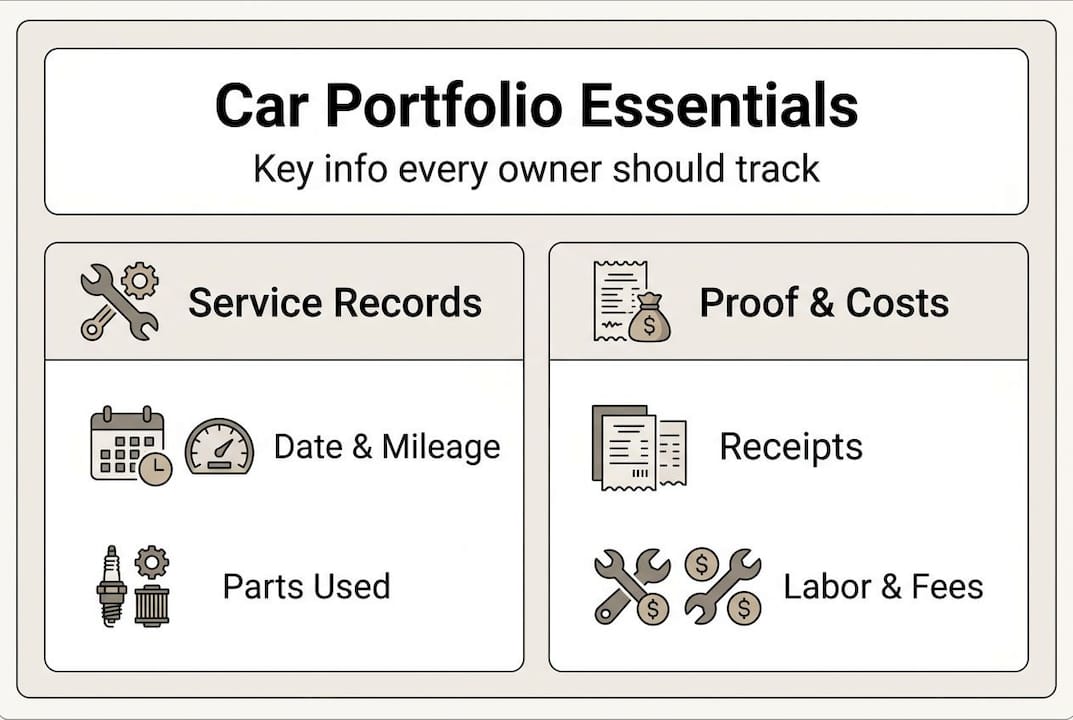
Here is a simple reference table to visualize what to track:
| Category | What to record | Why it matters |
|---|---|---|
| Identity | VIN, year, make, model, trim | Confirms specs for insurance and resale |
| Ownership | Purchase date, price, seller info | Establishes provenance |
| Service records | Date, mileage, service type, shop | Proves maintenance consistency |
| Parts and repairs | Brand, part number, cost | Supports warranty and resale claims |
| Modifications | What was changed, who did it, when | Affects value and insurance coverage |
| Photos | Condition at purchase, after repairs | Visual proof of history |
| Documents | Title, registration, warranty, recalls | Legal and financial protection |
To build this out from scratch, follow these steps:
- Gather every document you currently have, physical or digital.
- Organize them by category using the table above as your guide.
- Identify gaps — missing years, unknown service history, or unlogged repairs.
- Fill gaps by contacting previous service centers or requesting records from dealerships.
- Set a recurring reminder to update the portfolio after every service visit.
Pro Tip: Log every service, even a basic tire rotation or a cabin air filter swap. These small entries build a continuous record that signals to buyers and insurers that the car was cared for consistently. Learning how to track car maintenance properly makes this habit much easier to sustain. You can also use a car maintenance checklist to make sure nothing falls through the cracks.
The goal is not perfection from day one. It is building a habit that compounds over time.

Digital vs. physical car portfolios: Which is best?
Once you know what to collect, you need to decide how to store it. The honest answer is that neither format wins outright — it depends on your situation.
Digital tools and apps like MyRide901 and GarageHub enable logging, reminders, sharing timelines and PDFs, and multi-vehicle management. Physical options include custom leather binders that work especially well for classic cars where provenance and original paperwork carry real value.
Here is a side-by-side comparison:
| Feature | Digital portfolio | Physical portfolio |
|---|---|---|
| Searchability | Instant keyword search | Manual flipping |
| Backup and safety | Cloud storage, multiple copies | Risk of fire, flood, or loss |
| Sharing | Email or link in seconds | Requires physical handoff |
| Provenance for collectors | Less authentic feel | Original stamps and signatures |
| Reminders and alerts | Automated service reminders | Requires manual calendar entries |
| Cost | Free to low-cost apps | Binder, sleeves, printing costs |
For daily drivers and multi-car owners, digital wins on almost every dimension. You can pull up records from your phone in a service bay, share a full history with a potential buyer in seconds, and never lose a receipt again. Guides on digital car recordkeeping walk through the best platforms and workflows for getting started.
For collectors, the calculus shifts. An original service book with dealer stamps, handwritten notes from a previous owner, and factory window stickers carry emotional and financial weight that a PDF simply cannot replicate. In those cases, physical files are the foundation and digital copies serve as backup.
Pro Tip: Use a digital app for daily searchability and automated service reminders, but always keep physical originals for rare or classic vehicles. Scan every original document so you have both. Platforms built around car ownership tracking make this hybrid approach straightforward.
The worst outcome is doing neither. A scattered mix of unsorted receipts in the glove box and a few photos on your phone is not a portfolio — it is a liability.
How to build and manage your car's portfolio
Building a portfolio from scratch feels overwhelming until you break it into stages. The process is simpler than most people expect, especially with the right tools.
Follow these steps to get started:
- Start with what you have. Pull together every document, receipt, photo, and note related to the vehicle. Do not worry about gaps yet.
- Organize by category. Use the component table from the previous section as your filing structure.
- Digitize physical records. Scan or photograph every paper document and store them in a cloud folder or dedicated app.
- Reconstruct missing history. Contact previous service centers, dealerships, or prior owners. Many shops keep records for several years and will provide copies on request.
- Set up reminders. Schedule recurring alerts for oil changes, tire rotations, and annual inspections so your portfolio stays current automatically.
- Review quarterly. A quick 10-minute review every three months catches anything that slipped through and keeps the record accurate.
Prioritize apps and spreadsheets for everyday owners because of their ease and searchability. Custom files work better for collectors who need to enhance provenance. The universal rule: log every service, even the small ones, to avoid gaps that raise red flags later.
"A portfolio with no gaps tells a story of care. A portfolio with missing years tells a story of neglect — whether that is true or not."
The vehicle service history guide covers how consistent documentation directly connects to resale outcomes, which is motivation enough to stay on top of it.
The key insight here is that managing a portfolio is not a one-time project. It is a lightweight ongoing habit that pays off every time you negotiate a sale, file a claim, or walk into a service center knowing exactly what has already been done.
Why most car owners underestimate the power of a car portfolio
Here is the uncomfortable truth: most owners treat their car portfolio as an afterthought because the consequences of neglect are invisible until they are not. You only discover the cost of missing records when a buyer walks away, an insurer disputes a claim, or a warranty gets denied over an undocumented service.
The conventional wisdom says keep your title, registration, and insurance card. That is the bare minimum for legal compliance, not for smart ownership. Manufacturers, insurers, and buyers in 2026 increasingly expect full-service histories. Lax documentation is no longer a minor inconvenience — it is a negotiating disadvantage.
One overlooked oil change or an unlogged repair can literally shift a resale negotiation by hundreds or even thousands of dollars. Reviewing a vehicle history checklist before buying or selling reveals exactly how much weight buyers place on complete records.
Well-organized portfolios also surface patterns that owners would otherwise miss entirely. A recurring coolant top-off every few months, logged consistently, tells a very different story than a surprise overheating event with no prior documentation. The portfolio becomes a diagnostic tool, not just a filing cabinet.
The owners who treat their portfolio seriously are not obsessive — they are simply protecting one of their largest financial assets with the same discipline they would apply to any other investment.
Take control: Manage your car's portfolio effortlessly
Building and maintaining a car portfolio does not have to be a manual chore. AutoManual gives you a single, secure place to digitize, update, and access your complete vehicle records whenever you need them.
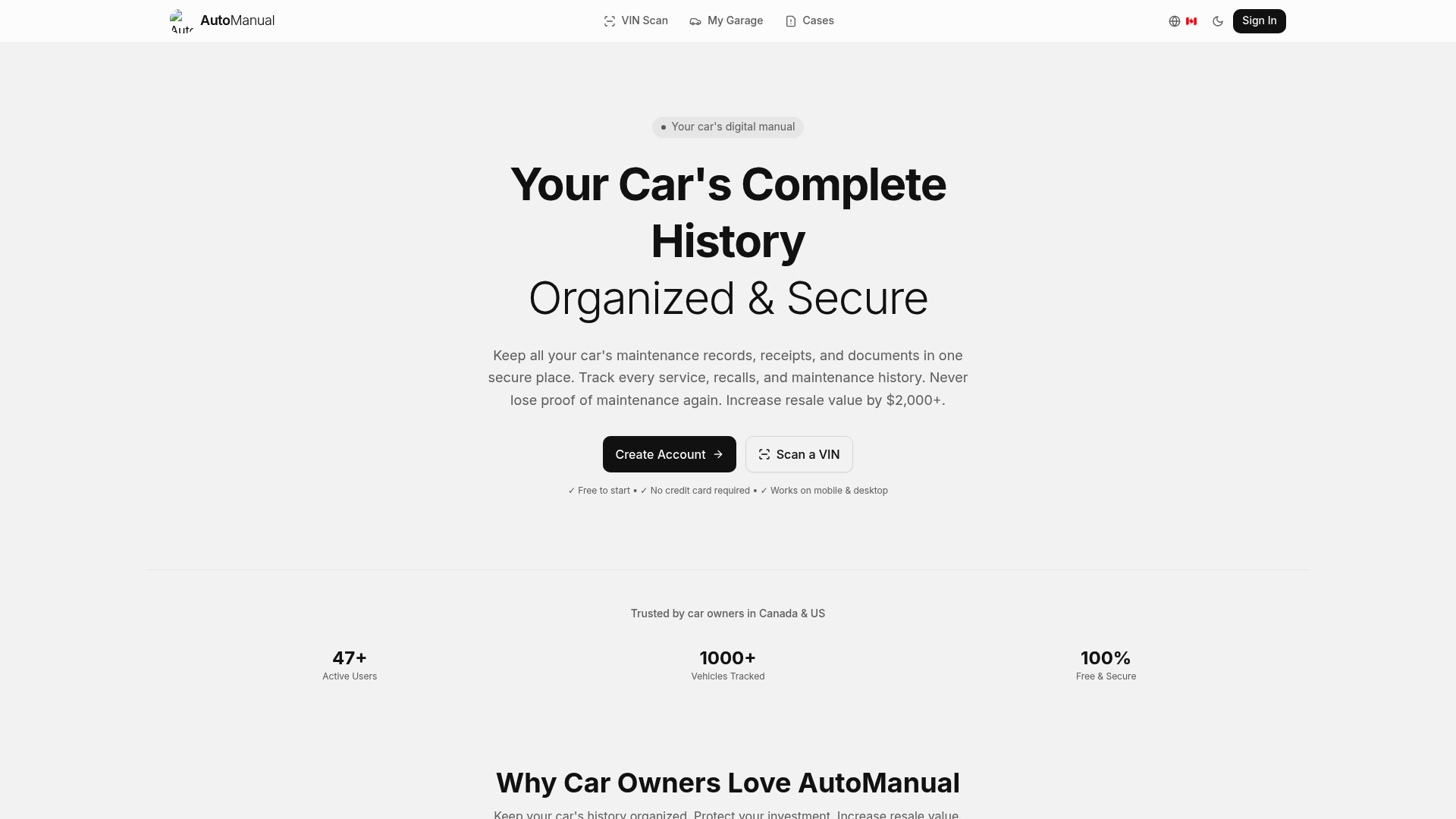
With AutoManual, you get integrated reminders, document storage, and easy sharing so your portfolio is always current and ready to impress buyers, insurers, or service centers. You can enter any VIN through AutoManual Scan to instantly pull full technical specs and start building your digital garage right away, no signup required. The AutoManual platform also supports multi-vehicle management, so whether you own one car or ten, every record stays organized and accessible in one place. Start today and turn your vehicle history into a real asset.
Frequently asked questions
What are the main benefits of keeping a car's portfolio?
A well-kept car portfolio makes resale easier, speeds up insurance claims, and ensures your maintenance and repairs are always tracked. Car portfolios improve sale, insurance, and service outcomes consistently.
Is it better to keep a car portfolio digitally or physically?
Digital portfolios are best for convenience and searchability, while physical versions suit collectors who value provenance. Digital tools enable logging and multi-vehicle management that paper simply cannot match.
How can I recover missing records for my car's portfolio?
Start by contacting previous owners or service centers and use digital apps to request any missing documentation. Apps and service records help reconstruct missing history more completely than most owners expect.
Does keeping detailed service records actually increase resale value?
Yes — buyers are more likely to pay a premium for cars with full service histories because it reduces their risk. Vehicle portfolios maximize resale by proving consistent care and documented history to every potential buyer.