
TL;DR:
- Essential safety features like AEB and airbags significantly reduce crashes and injuries.
- Well-designed UI and simple controls improve driver safety and reduce distraction risks.
- Prioritizing proven, standard safety systems over feature overload enhances long-term satisfaction and safety.
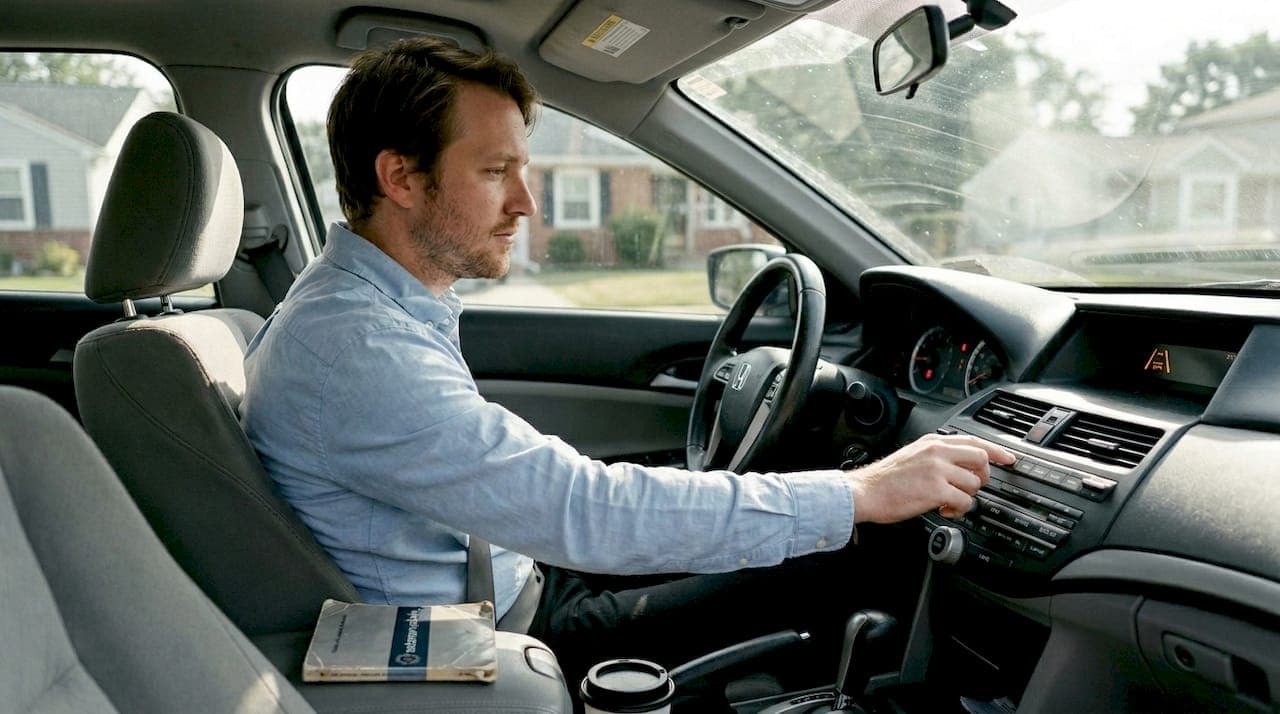
Most car buyers assume a longer feature list means a better, safer vehicle. That logic feels intuitive, but the evidence tells a more complicated story. Some features genuinely reduce crashes and injuries. Others add complexity without measurable benefit. And a few, depending on how they're designed, can actually make driving more dangerous. Understanding which features matter, why they matter, and how they interact with your daily driving habits is the difference between buying smart and buying blind. This guide cuts through the noise so you can make decisions based on real data, not marketing copy.
Table of Contents
- Understanding the evolution of car features
- How safety features truly influence accident outcomes
- The user experience factor: UI, UX, and feature overload
- Dashboard symbols and your safety: the hidden compliance link
- Why less can be more: the overlooked value of simplicity in car features
- Take control of your features with AutoManual
- Frequently asked questions
Key Takeaways
| Point | Details |
|---|---|
| Safety features matter most | Features like AEB and PAEB significantly lower crash and injury rates based on real-world data. |
| Good UX beats feature overload | Simple, intuitive interfaces are safer than overwhelming dashboards with too many controls. |
| Know your dashboard symbols | Understanding warning lights and symbols directly affects your safety and maintenance habits. |
| Evidence trumps hype | Rely on research-backed features, not just marketing claims, for safer smart buying. |
Understanding the evolution of car features
Car features have come a long way from the days when seat belts were considered optional extras. In the 1960s, lap belts became standard. By the 1990s, airbags were mandatory in the U.S. Today, vehicles ship with radar sensors, cameras, and onboard computers that can detect pedestrians, read lane markings, and apply brakes without driver input. The pace of change is genuinely staggering.
But not every innovation earns its place. There's a meaningful difference between features that are essential and those that are simply nice to have. Essential features directly reduce crash risk or protect occupants during a collision. Nice-to-have features improve comfort or convenience without a proven safety impact. Knowing which category a feature falls into helps you prioritize when comparing vehicles.
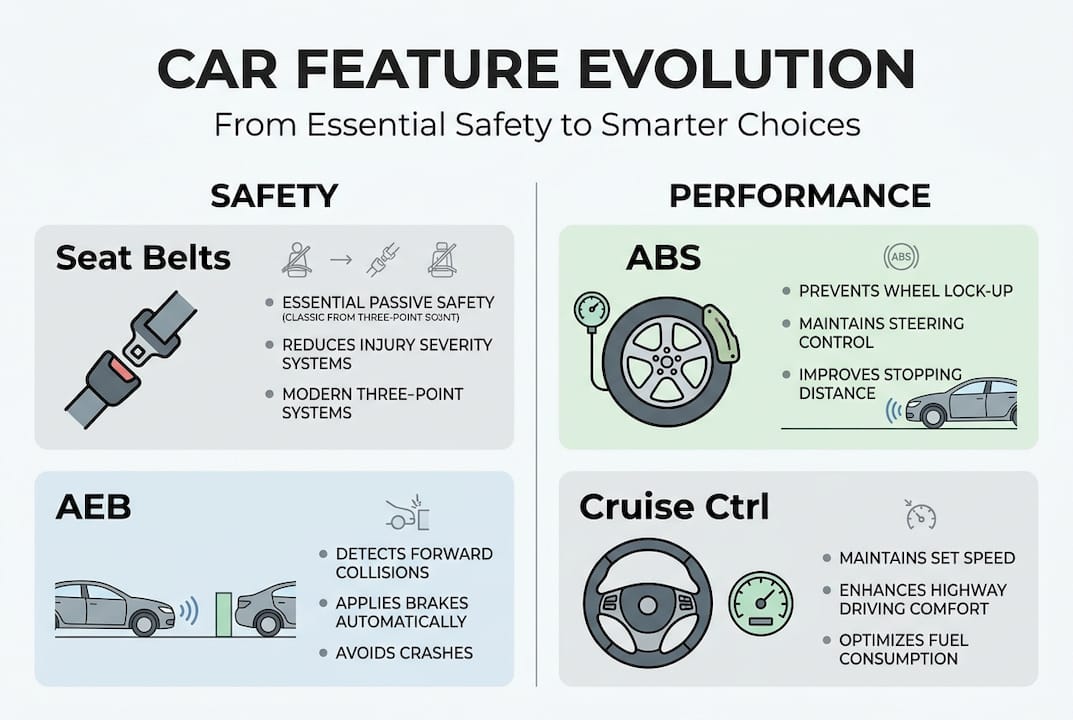
Advanced Driver Assistance Systems, known as ADAS, sit at the center of this conversation. ADAS is an umbrella term for technologies like automatic emergency braking, lane-keep assist, blind-spot monitoring, and adaptive cruise control. These systems have been studied extensively, and the results are mixed in ways that might surprise you.
ADAS effectiveness improving is well-documented for certain technologies, with Automated Emergency Braking (AEB) reducing crash rates from a 46% to a 52% reduction across model years 2015 to 2023. However, the same research found no meaningful safety gains from adaptive cruise control. That's a significant finding. A feature marketed heavily by automakers may offer zero crash reduction benefit.
Here's a quick look at how key safety milestones have stacked up over the decades:
| Era | Feature introduced | Primary benefit |
|---|---|---|
| 1960s | Seat belts | Occupant restraint |
| 1980s | Anti-lock brakes (ABS) | Steering control during braking |
| 1990s | Airbags | Impact absorption |
| 2000s | Electronic stability control | Rollover and skid prevention |
| 2010s | AEB, lane-keep assist | Pre-crash intervention |
| 2020s | Full ADAS suites | Multi-system crash avoidance |
When you understand how car specs shape decisions, it becomes clear that raw spec sheets rarely tell the full story. Features need context. A vehicle loaded with ADAS tech is only as good as the specific systems it includes and how well those systems perform in real-world conditions. If you want to compare car models effectively, look past the feature count and focus on tested, documented performance.
Key takeaways from the evolution of car features:
- Seat belts and airbags remain among the highest-impact safety features ever introduced
- ABS and electronic stability control have strong, consistent safety records
- ADAS effectiveness varies significantly by specific technology
- Adaptive cruise control has not shown measurable crash reduction in current research
How safety features truly influence accident outcomes
Not all safety features are created equal. When it comes to real-world crash reduction, the data points clearly to a handful of technologies that consistently outperform the rest.
Automated Emergency Braking (AEB) detects an imminent forward collision and applies the brakes automatically if the driver doesn't respond in time. Pedestrian AEB (PAEB) is a variation that specifically identifies pedestrians and cyclists in the vehicle's path.
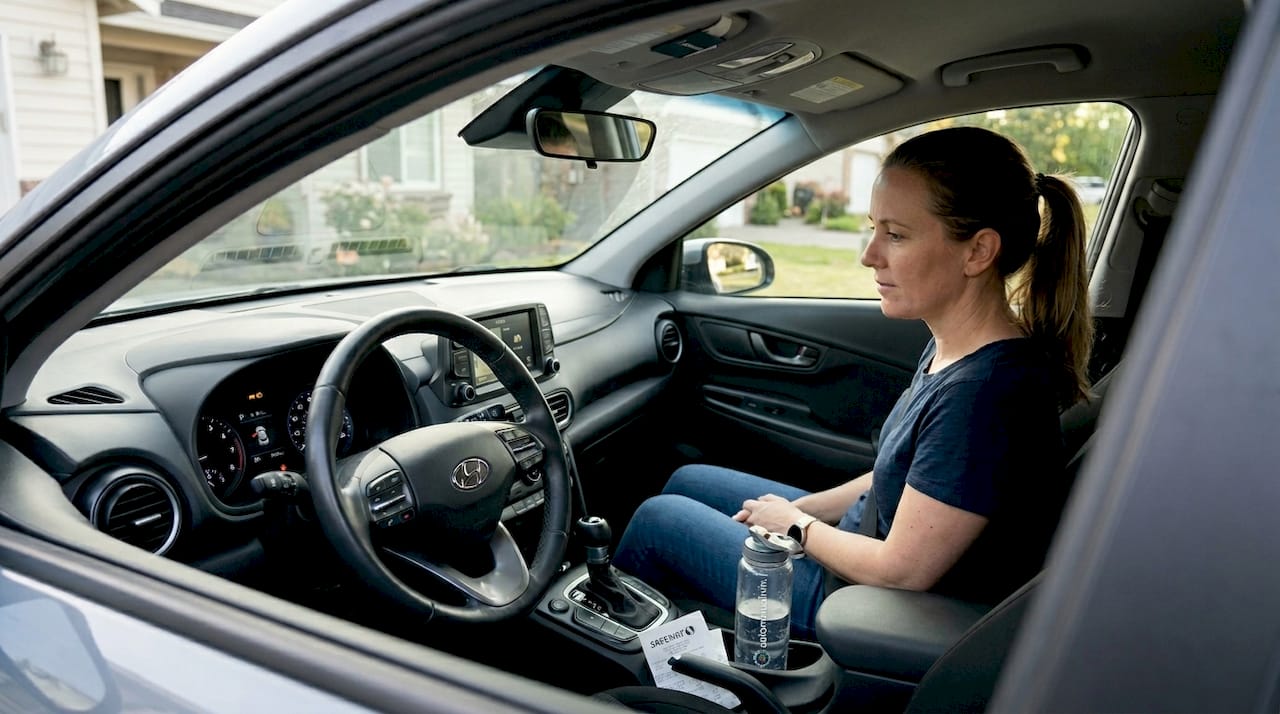
The numbers behind these systems are striking. AEB reduces rear-end crashes by 50% and injuries by 56%, with newer 2021 to 2023 models showing up to 60% fewer rear-end injury crashes. That's not a marginal improvement. That's a technology that meaningfully changes outcomes. Meanwhile, PAEB cuts single-vehicle frontal crashes with non-motorists by 9%, a smaller but still meaningful reduction given how often pedestrian collisions result in fatalities.
Here's how major safety features compare based on documented evidence:
| Feature | Crash reduction | Injury reduction | Evidence strength |
|---|---|---|---|
| AEB | ~50% rear-end crashes | ~56% injuries | Strong |
| PAEB | ~9% frontal crashes | Moderate | Moderate |
| Lane-keep assist | Varies | Limited data | Mixed |
| Adaptive cruise control | No reduction found | No reduction found | Weak |
| Electronic stability control | ~35% rollover reduction | Significant | Strong |
Steps to evaluate safety features before buying:
- Check whether the vehicle has standard AEB, not just as an optional add-on
- Confirm PAEB is included, particularly if you drive in urban environments
- Look up IIHS or NHTSA ratings for the specific model year
- Ask the dealer which ADAS features are active by default versus requiring manual activation
- Review your car maintenance guide to understand how sensors and cameras need regular upkeep to stay effective
Pro Tip: When prioritizing safety features, focus your budget on vehicles with standard AEB rather than paying a premium for large ADAS packages that include unproven technologies like adaptive cruise control.
The user experience factor: UI, UX, and feature overload
Even the most effective safety system can fail if the driver can't use it properly. This is where user interface (UI) and user experience (UX) design become critical, and where many modern vehicles quietly underperform.
UI refers to the physical and digital controls you interact with: buttons, touchscreens, knobs, and voice commands. UX is the broader experience of how intuitive and stress-free those interactions feel during actual driving. A poorly designed touchscreen that requires three taps to adjust the climate control is a distraction hazard, regardless of how many features the car offers.
Research on cockpit design confirms this directly. Eye-tracking and voice control are identified as key tools to minimize distraction, while complex interfaces are flagged as a serious risk in edge cases like driver fatigue. When you're tired, the last thing you need is a confusing menu system between you and a critical function.
"The most dangerous moment in a feature-rich vehicle isn't a system failure. It's a driver who can't find the right button at the wrong time."
UI and UX innovations that genuinely improve safety:
- Voice control for navigation, calls, and climate without taking eyes off the road
- Haptic feedback on steering wheel controls for confirmation without visual checks
- Heads-up displays (HUDs) that project speed and navigation onto the windshield
- Simplified home screens that surface only the most critical information
- Physical knobs for frequently used functions like volume and temperature
The irony is that automakers often add features to justify higher price points, not because those features make the car safer or easier to use. A vehicle with 40 touchscreen functions and a confusing menu structure may actually be less safe than a simpler car with well-placed physical controls. Understanding car specs and user experience together gives you a far more accurate picture of what daily ownership will actually feel like.
Pro Tip: Before buying, sit in the driver's seat and try to adjust the temperature, change a radio station, and activate navigation without help. If it takes more than two steps for any of those tasks, the UX may be a liability on the road.
Dashboard symbols and your safety: the hidden compliance link
One of the most overlooked safety factors in vehicle ownership isn't a feature at all. It's whether drivers understand what their dashboard is telling them. Dashboard symbol comprehension directly impacts maintenance compliance, and poor understanding leads to neglected safety features that quietly degrade over time.
A warning light ignored is a safety system potentially disabled. The tire pressure monitoring system (TPMS) light, for example, is frequently dismissed as minor. But underinflated tires reduce braking effectiveness and increase blowout risk, directly undermining the performance of AEB and stability control systems that depend on proper tire contact.
Here's a quick reference for commonly misunderstood symbols:
| Symbol | What it means | Urgency |
|---|---|---|
| TPMS (tire pressure) | One or more tires underinflated | Address within 24 hours |
| Check engine | Engine or emissions fault | Diagnose within 1 week |
| Battery warning | Charging system failure | Stop driving soon |
| Oil pressure | Oil pressure critically low | Stop immediately |
| ABS warning | Anti-lock braking system fault | Diagnose before highway driving |
| ADAS/camera warning | Sensor blocked or system fault | Recalibrate before relying on ADAS |
Steps to improve your dashboard symbol literacy:
- Read your car manuals guide to identify every symbol in your specific vehicle
- Create a reference card for the five most critical warning lights
- Use a digital platform to track car maintenance and correlate warnings with service history
- Follow a car maintenance checklist to stay ahead of issues before warning lights appear
Pro Tip: If a symbol appears that you don't immediately recognize, pull over safely and look it up before continuing. Guessing is not a strategy when it comes to warning lights.
Why less can be more: the overlooked value of simplicity in car features
Here's something most dealerships won't tell you: the happiest, safest drivers are often not the ones with the most features. They're the ones who deeply understand and consistently use the features they have.
There's a real cost to feature overload. Drivers who feel overwhelmed by their vehicle's interface are more likely to disable safety systems, ignore warnings, or simply stop engaging with tools that could protect them. A car with 12 ADAS features that the driver uses two of is not a safer car. It's a more expensive one.
The vehicles that tend to earn the highest long-term owner satisfaction aren't always the most technologically loaded. They're the ones where every feature feels intentional, every control is where you'd expect it, and the learning curve doesn't last six months. That's good design. And good design, frankly, is rarer than a long feature list.
Our perspective at AutoManual is that buyers should resist the pull of feature maximalism. Prioritize your actual driving patterns. If you commute in a city, PAEB matters more than a panoramic sunroof. If you drive long highway miles, AEB and lane-keep assist deserve your attention. Knowing what you actually need is a skill, and it starts with understanding what features genuinely do. Learning to track car maintenance benefits over time is one of the best ways to stay connected to your vehicle's real performance rather than its marketing story.
Take control of your features with AutoManual
Understanding your car's features is only half the equation. The other half is staying on top of them over time, knowing when sensors need recalibration, when warnings need attention, and what your vehicle's full spec sheet actually includes.
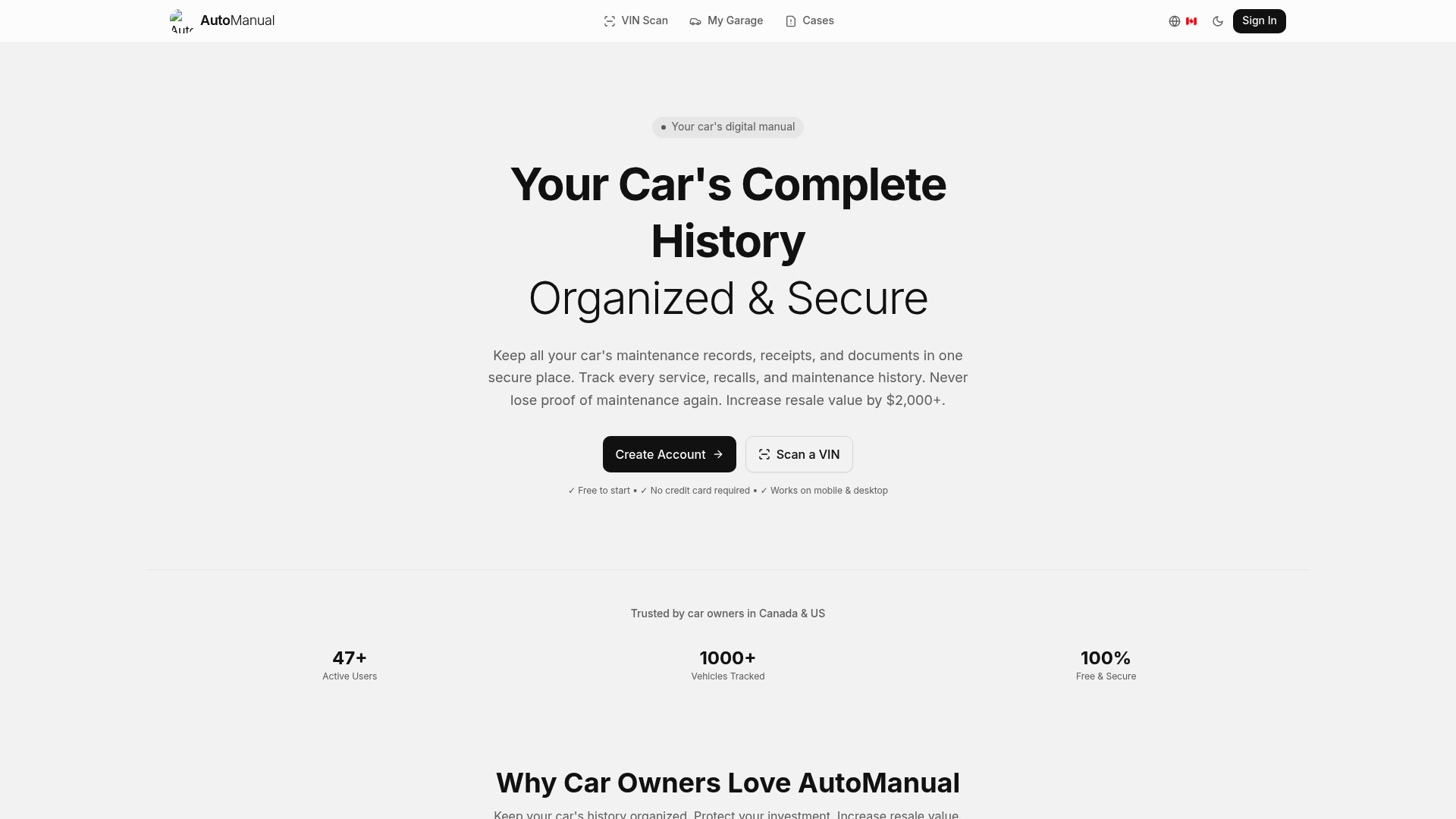
AutoManual gives you instant access to your vehicle's complete technical specs by entering any VIN, no signup required. You can build a digital car profile that tracks maintenance history, stores documents, and keeps every ownership detail in one place. Whether you're buying your next car or getting more from the one you have, AutoManual puts the information you need right at your fingertips. Start with your VIN and see exactly what your car is built to do.
Frequently asked questions
Which car features have the greatest impact on safety?
Automated Emergency Braking and Pedestrian AEB have the strongest proven track records, with AEB cutting rear-end crashes by 50% and injuries by 56%, while PAEB reduces frontal crashes with non-motorists by 9%.
Why does understanding dashboard symbols matter?
Missed or misread warning lights lead directly to neglected maintenance and disabled safety systems. Poor symbol comprehension is a documented driver of reduced safety compliance and higher long-term repair costs.
Is a more complex user interface always better?
No. Research shows that complex interfaces overwhelm drivers in high-stress scenarios like fatigue, making simpler, well-designed controls a genuine safety advantage.
How can I ensure I'm not missing out on important car features?
Start with your car's manual to understand every feature, use a digital profile to track maintenance and specs, and regularly review warning light meanings so nothing slips through the cracks.